
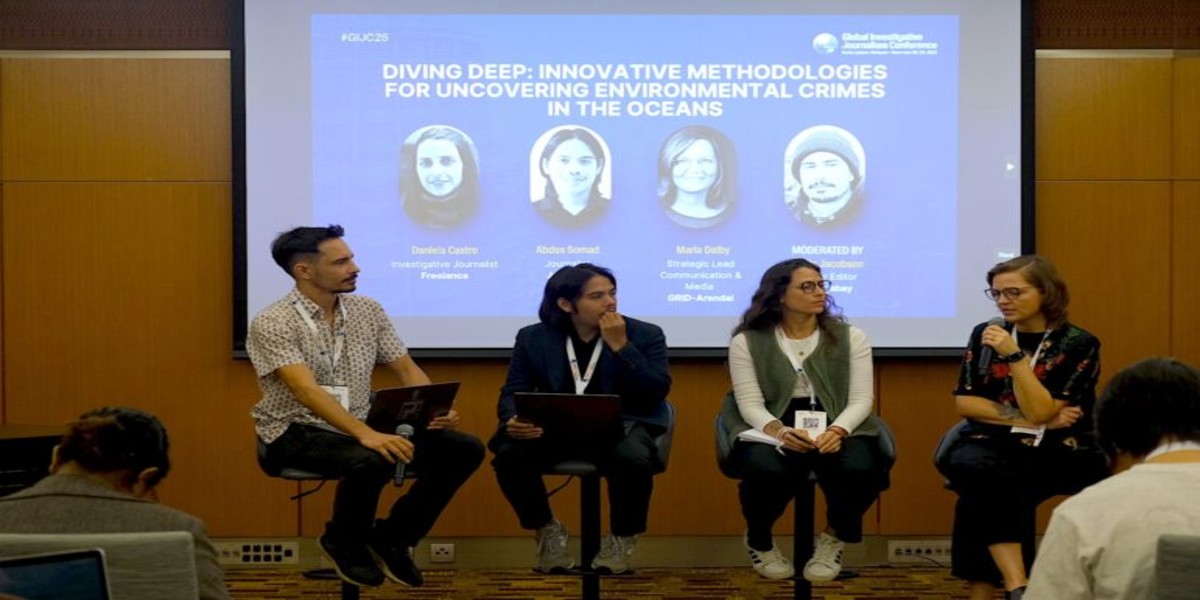

LAHORE: Investigative journalists are increasingly combining satellite imagery, vessel-tracking technology, corporate records and information obtained from coastal communities to uncover environmental crimes at sea, including illegal fishing and wildlife trafficking.
The approaches were highlighted at the 14th Global Investigative Journalism Conference (GIJC25), where international experts and reporters discussed practical methods for investigating maritime crimes despite limited documentation, weak enforcement and gaps in government oversight.
In an article published on December 3, 2025, investigative journalism resource organization Global Investigative Journalism Network (GIJN) outlined several techniques that journalists can use to trace suspicious shipping activities, investigate corporate ownership and identify potential violations of environmental regulations.
Daniela Castro, an investigative reporter formerly associated with the Organized Crime and Corruption Reporting Project (OCCRP), presented a cross-border investigation into shark-fin trafficking that began with a Colombian government announcement about the seizure of an illicit shipment.
The investigation focused on information missing from official statements, including the exporter’s identity, permit details and questions surrounding the shipment’s legality.
By combining previously leaked material with public business registries and corporate filings, the investigative team identified the exporter and uncovered links that warranted further scrutiny.
Castro emphasized that journalists must develop their own documentary records rather than rely exclusively on official statements. Her approach demonstrated how missing information can become a starting point for deeper investigations into suspected environmental crimes.
The investigation also demonstrated the value of systematically requesting records from multiple government departments.
Over nine months, Castro’s team submitted more than 45 freedom-of-information requests to Colombian agencies, including fisheries authorities, tax and customs offices, and maritime regulators.
A structured spreadsheet was used to record the agencies contacted, the purpose of each request and the responses received.
Combined with field reporting in Colombia, Venezuela and Hong Kong, the information helped the team reconstruct aspects of the shipment and identify gaps in the company’s permits.
The methodology offers a potential model for journalists investigating cross-border trafficking, illegal fishing and other maritime activities involving multiple jurisdictions.
Indonesian journalist Abdus Somad of Jaring.id presented another approach based on combining Automatic Identification System (AIS) vessel-tracking data with information gathered from coastal communities.
AIS technology allows journalists to examine vessel movements and identify unusual routes or interruptions in tracking signals. However, ships involved in suspicious activities may switch off their transponders, transmit misleading location information or change course unexpectedly.
To investigate such incidents, reporters can compare vessel movements across platforms such as Global Fishing Watch, MarineTraffic, FleetMon and VesselFinder.
Satellite imagery can provide additional evidence to assess whether a vessel’s reported movements correspond with observed activity.
Journalists can also examine publicly available videos and posts on TikTok and Facebook, seek information from fishing communities and interview eyewitnesses who may have observed foreign vessels, landings or suspicious transfers at sea.
Vessel ownership databases, including Equasis, can help reporters identify registered companies and investigate corporate relationships associated with ships.
However, tracking anomalies alone do not establish that a crime has occurred. Independent corroboration, documentary evidence and responses from the relevant parties remain essential to responsible reporting.
The conference discussions also highlighted the importance of international environmental agreements and the implementation of emerging maritime rules.
The Biodiversity Beyond National Jurisdiction (BBNJ) Agreement establishes a framework for conserving and sustainably using marine biodiversity in areas beyond national jurisdiction. Its implementation can provide journalists with opportunities to examine how governments fulfil their commitments.
Meanwhile, negotiations toward a global plastics treaty have raised questions about plastic pollution, waste exports and the international movement of plastic waste.
Investigative reporters can examine whether governments and businesses comply with applicable rules, how environmental assessments are conducted and whether regulatory weaknesses allow harmful activities to continue.
The methods discussed at GIJC25 demonstrate how digital tools, public records and community-based reporting can complement traditional investigative journalism.
For journalists working on ocean-related environmental crimes, the central challenge is to establish verifiable connections between vessel movements, corporate ownership, shipping documents, environmental damage and the people or organizations potentially responsible.
Combining these sources can help reporters investigate activities that might otherwise remain hidden across international waters and fragmented regulatory systems.
As pressure grows to protect marine ecosystems, investigative journalism can play an important role in examining enforcement failures, scrutinizing corporate conduct and bringing credible evidence of suspected environmental wrongdoing into the public domain.
Reported By: Mirza Maqbool Baig | Senior Reporter