
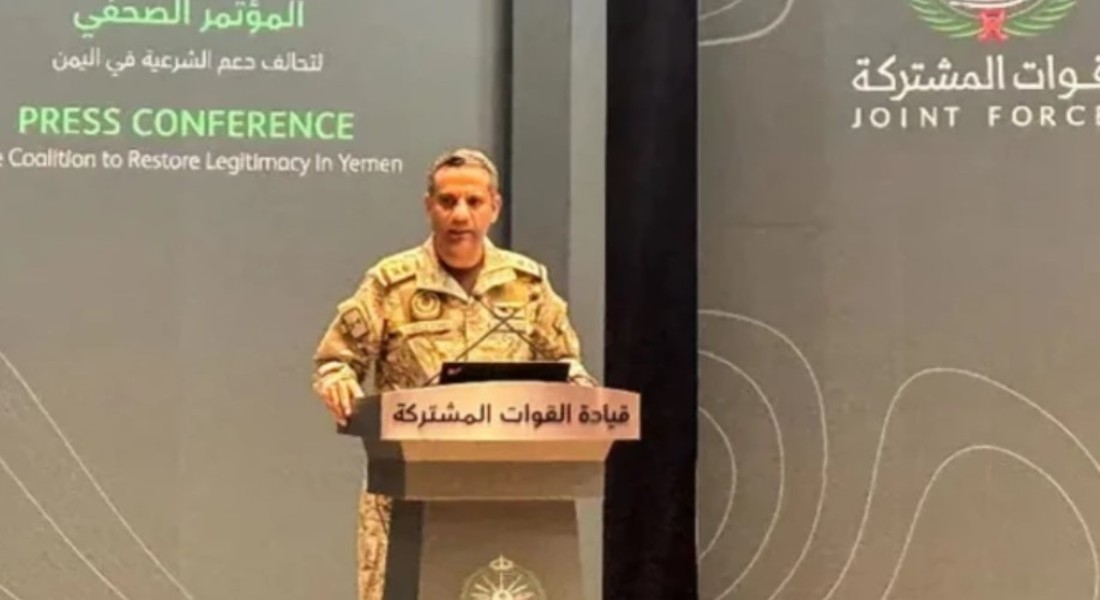
RIYADH: The Saudi-led coalition said on Sunday that it had carried out a military operation to “disable important resources” the Houthi group uses to support its war and build up its military strength, especially missiles and drones.
Coalition spokesperson Turki al-Maliki said the operation took place on Sunday morning after continued Houthi attacks on civilians and civilian sites in Yemen and Saudi Arabia.
The coalition’s joint forces command had tracked the Houthis’ “continued use of important resources to support their war effort and strengthen their military capabilities, especially missiles and drones,” he said.
Al-Maliki said the attacks directly threatened civilians and civilian facilities.
He said the operation aimed to disable resources the group used to carry out repeated attacks and threaten security in Saudi Arabia and Yemen, as well as shipping routes in the southern Red Sea.
The statement did not say where the targets were or what resources had been disabled. It also gave no information about casualties or damage.
The Houthis did not immediately comment.
Since October 5, Yemeni government forces have launched Operation “Dawn of Yemen” to regain government institutions from Houthi control and retake the capital, Sanaa.
Fighting between government forces and the Houthis began again in July. Thousands have been killed or wounded, and more than 250,000 people have been forced to leave their homes, according to UN reports.
The fighting ended a period of relative calm that had lasted in Yemen since April 2022. The humanitarian crisis has worsened as fighting and displacement continue.
Yemen has been at war since the Houthis took Sanaa and several other provinces in September 2014. A Saudi-led coalition began military action in March 2015 to support the internationally recognised government.
Iranian state media says strike on Saudi industrial site caused large fire
A strike on an industrial site in Dammam, Saudi Arabia, caused a large fire on Sunday, Iran’s state-run IRNA news agency reported.
“A Yemeni strike hit an industrial complex in Dammam, eastern Saudi Arabia, causing a large fire at the site,” IRNA said in a post on X.
On Thursday, the Houthis said 12 people had been killed and three seriously injured in what they called Saudi strikes on homes in western Yemen. The group’s health ministry said two families’ homes were hit in Al-Barah, in Maqbana district.
The claims could not be independently confirmed. The Houthis had also reported at least 14 deaths in Saudi strikes on a petrol station and market on Wednesday. The group also attacked the airport in Aden, a stronghold of Yemen’s internationally recognised government, injuring civilians.
The latest fighting followed the breakdown of a 2022 truce in July. The Houthis allowed an Iranian plane to land in Sanaa despite Saudi control of Yemeni airspace. This led to renewed attacks, and the group later targeted Saudi territory, ships and oil facilities.
The Houthis have increased their attacks on Saudi Arabia, including strikes on Riyadh airport that forced it to close for two weeks and led to major events being cancelled. The attacks have also threatened Saudi Arabia’s plans to diversify its economy.
Yemen has been in conflict since 2014, when the Houthis took the capital, Sanaa. A Saudi-led coalition intervened the following year to support the government. More than 1,600 people have been killed and over 275,000 forced from their homes since fighting resumed, according to the United Nations.
Yemen appoints governors for two provinces partly controlled by Houthis
Separately, Yemen’s Presidential Leadership Council issued two orders on Sunday, naming new governors for al-Bayda in central Yemen and al-Jawf in the north. The Houthis control parts of both provinces.
The government-run Saba News Agency said Major General Hussein al-Ajji Ali al-Awadhi was named governor of al-Bayda. Major General Amin Ali al-Akimi was named governor of al-Jawf and commander of its military area.
Al-Awadhi replaces former al-Bayda governor Nasser al-Sawadi. Al-Akimi takes over al-Jawf from al-Awadhi, who had been the province’s governor.
The appointments come as fighting continues in both provinces, with government forces and the Houthis battling for control of key areas.
The Houthis control most of al-Bayda. Control of al-Jawf is shared between the group and government forces.
Al-Bayda is important because of its central position in Yemen and its borders with eight other provinces—four in the north and four in the south.
Al-Jawf is also important for military and geographic reasons. It shares a border with Saudi Arabia and is near the Houthi-controlled provinces of Saada, Amran and Sanaa. It also borders Marib and Hadhramaut, which are controlled by the government.
Since October 5, Yemeni government forces have launched Operation “Dawn of Yemen” to regain government institutions from Houthi control and retake the capital, Sanaa.
Fighting between government forces and the Houthis began again in July. Thousands have been killed or wounded, and more than 250,000 people have been forced to leave their homes, according to UN reports.
The fighting ended a period of relative calm that had lasted in Yemen since April 2022. The humanitarian crisis has worsened as fighting and displacement continue.
Yemen has been at war since the Houthis took Sanaa and several other provinces in September 2014. A Saudi-led coalition began military action in March 2015 to support the internationally recognised government.
Reported By: Our Correspondent Reporter