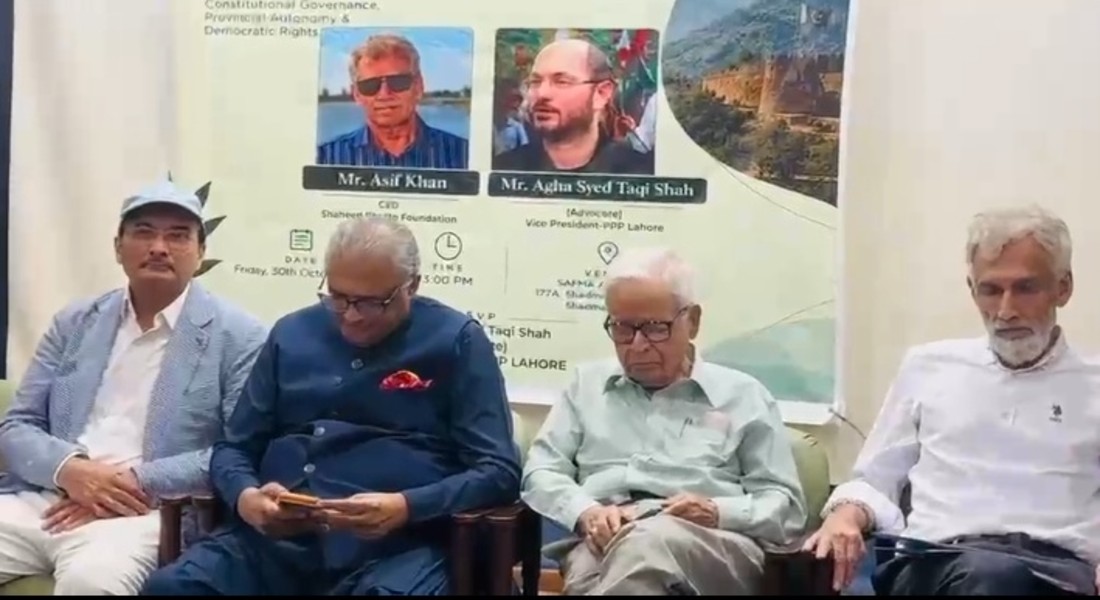
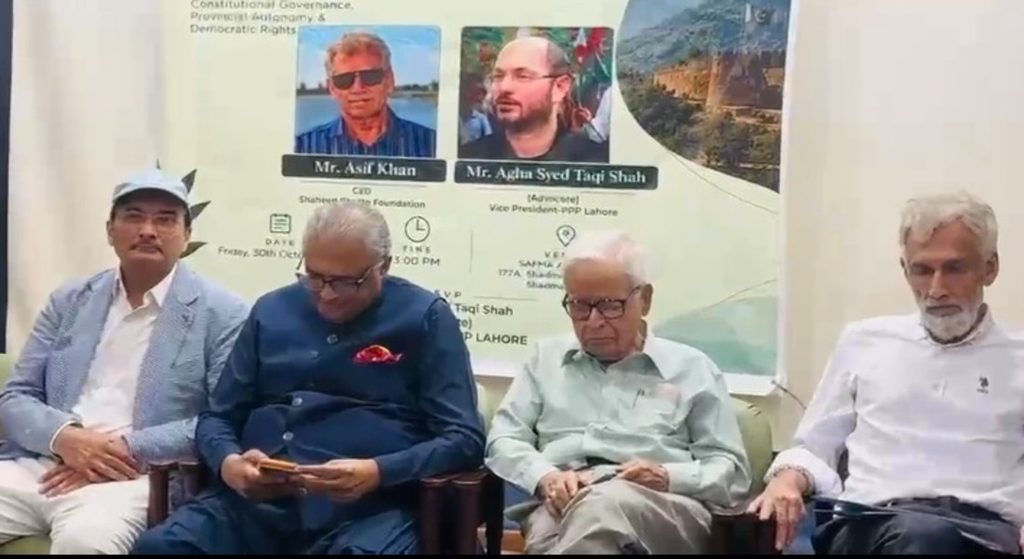
LAHORE: A discussion forum titled “Democracy, Emergency, Constitutional Instability, and the Future of Khyber Pakhtunkhwa,” organized by the Shaheed Bhutto Foundation was held at the SAFMA Secretariat.
The session was presided over by senior analyst Sohail Warraich, with Faisal Mir attending as the chief guest. Agha Taqi served as the moderator. Addressing the forum, Sohail Warraich stated that instead of conflict, the focus should be on fostering unity.
He remarked that the Pakistan Peoples Party (PPP) remains unmatched in terms of its track record of sacrifices; any comparison with the PPP would only be valid if another party in Pakistan demonstrates a similar level of sacrifice.
He cautioned against challenging the democratic credentials of others, noting that a true democrat is one who upholds democratic principles even while in power. Warraich described the imposition of an emergency as being akin to a “divorce” within a government, emphasizing the need to return to normalcy.
He noted that Zia-ul-Haq was brought to power specifically to initiate the conflict in Afghanistan. He further remarked that if the Taliban’s system is considered so exemplary, then those who support it should relocate there. He stressed that it is essential for everyone to speak up to set the historical record straight.
Chief guest Faisal Mir stated that the PPP has no policy that supports the imposition of an emergency. He noted that the circumstances under which the PPP supported an emergency or Governor’s Rule are well-known. He added, “We do not wish to carry the funeral biers of Asif Zardari, Bilawal Bhutto, or Aseefa Bhutto.”
Mir also challenged the PTI to articulate its contributions toward democracy in Pakistan. He highlighted that political parties possess the capacity for resurgence, citing the example of how the PPP countered the MQM in Sindh. Faisal Mir claimed that the political strength of the PTI in Khyber Pakhtunkhwa is on the verge of collapse, much like that of the MQM.
He asserted that a provincial government cannot function in the absence of peace, a functioning assembly, and the constitution. He suggested that the federal government, the provincial administration, and the establishment should sit together to find a solution to end the state of emergency in Khyber Pakhtunkhwa as soon as possible.
Imtiaz Alam noted that a state of emergency was imposed in 1977, following the adoption of the 1973 Constitution; he described the imposition of an emergency as a “democratic sin” that is repeatedly committed in Pakistan.
He emphasized that, alongside reforms in the police, health, and education sectors, action must also be taken against various mafias. Regrettably, he added, all political parties including the PTI and JUI have effectively surrendered.
Tehreek-e-Insaf leader Ahmed Awais remarked that while a businessperson operates according to established rules (the “book”), landlords and feudal lords rely on sheer force.
In Pakistan, the constitution stands on one side, while a powerful military stands on the other. Hussain Naqi questioned the nature of the lawlessness in Khyber Pakhtunkhwa that served as the justification for imposing an emergency there.
He further observed that, in Pakistan, power has never truly been handed over to those who won it through democratic means. Agha Taqi served as the moderator for the event.
Reported By: Staff Reporter I Lahore