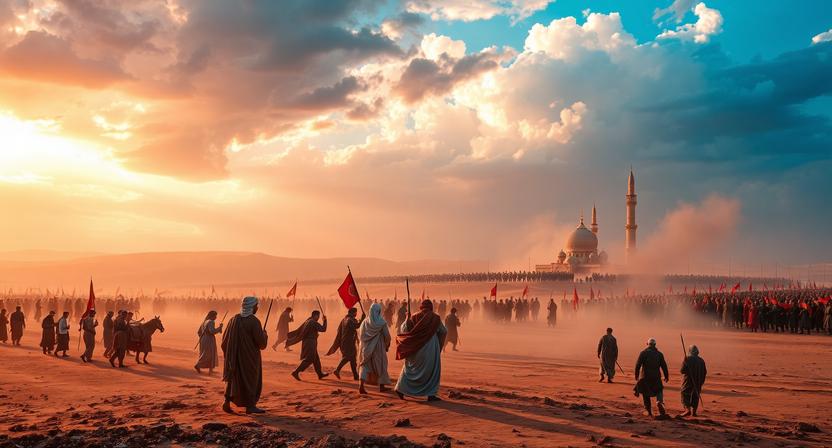
Every year, as the crescent of Muharram appears over Pakistan’s skies, the nation undergoes a profound transformation. Streets are draped in black, rhythmic chants echo through narrow alleys, and millions gather to mourn the martyrdom of Imam Hussain (RA) at Karbala.
Yet, for too long, the tragedy of 680 AD has been imprisoned within sectarian boundaries treated as the exclusive property of one community, viewed with suspicion by others. This is a profound misunderstanding. The true message of Karbala is not division; it is the universal blueprint for national unity, moral courage, and collective resistance against injustice.
Karbala was never a sectarian squabble. It was a cosmic stand between truth and falsehood, between tyranny and conscience. Imam Hussain did not rise for the political supremacy of his lineage; he rose because Yazid’s regime had openly abandoned the ethical foundations of Islam.
When Hussain declared, “I am not rising for mischief or tyranny, but to reform the nation of my grandfather,” he was speaking to all Muslims, across all ages and schools of thought. His sacrifice belongs to every believing heart—Sunni, Shia, or any other—that values justice over silence and dignity over submission.
In Pakistan, however, the tragedy has often been reduced to ritualistic grief that ends with the tenth of Muharram. We beat our chests, we weep, we distribute sabeel and then we return to our comfortable sectarian silos. The real tragedy is not that Hussain died; it is that we have forgotten why he lived.
His message was revolutionary: that standing alone against a corrupt system is more honorable than standing with a corrupt majority. This is a lesson Pakistan desperately needs today, as we face our own Yazids—not with swords, but with systemic inequality, institutional decay, and a politics that rewards sycophancy over integrity.
How, then, can Karbala become a force for national unity? First, by reclaiming Hussain as a shared heritage. Religious scholars from all schools must consciously emphasize the universal ethics of his stand, rather than the historical grievances that divide us.
The Paigham-e-Pakistan declaration, signed by thousands of clerics, has already shown that unity is possible when we focus on common Islamic values. The tragedy of Karbala must be taught in our schools not as a sectarian event, but as a moral case study in courage, sacrifice, and principled disobedience to oppression.
Second, unity requires moving beyond performative grief to substantive action. Imam Hussain did not merely weep for the oppressed; he sacrificed himself to break their chains. If we truly love Ahl al-Bayt, we must embody their ethos by standing with the marginalized in our society the poor, the minorities, the voiceless.
When a Shia mourner feeds a Sunni neighbor during Muharram, or when a Sunni scholar praises Hussain’s stand in a Friday sermon, the barriers of distrust begin to crumble. Unity is not an abstract ideal; it is a daily practice of mutual recognition and respect.
Third, we must use the digital space to counter hate. Social media currently amplifies the worst sectarian vitriol during Muharram. Instead, we can flood these platforms with stories of Hindu and Christian Pakistanis who have historically participated in azadari, or with examples from other Islamic civilizations where Karbala inspired poetry, philosophy, and art across all sects. Hussain belongs to no single group; his flag is the flag of human conscience.
Pakistan is bleeding from a thousand sectarian wounds, and Muharram often feels like salt rubbed into them. But it does not have to be this way. The tragedy of Karbala is, at its core, a tragedy of silence in the face of wrongdoing.
If Pakistani Muslims Sunni, Shia, and everyone in between can internalize this one lesson, we will find that our differences fade into insignificance compared to our shared struggles. We will realize that Yazid is not a historical figure but a recurring mentality, and Hussain is not a sectarian hero but a timeless mirror.
Let this Muharram be a turning point. Let us mourn, yes but let us also rise. Let us remember Karbala not as a wound that separates us, but as a bridge that connects us to our highest selves.
For in the final analysis, the army of Hussain was small, diverse, and vastly outnumbered yet it triumphed in eternity. Pakistan, too, can triumph over its divisions, if only we have the courage to hear Karbala’s true call.
Author’s Introduction: Ms. Sumra Farooq is an educator and writer with 20 years of experience. She can be reached at biyazdomain21@gmail.com.