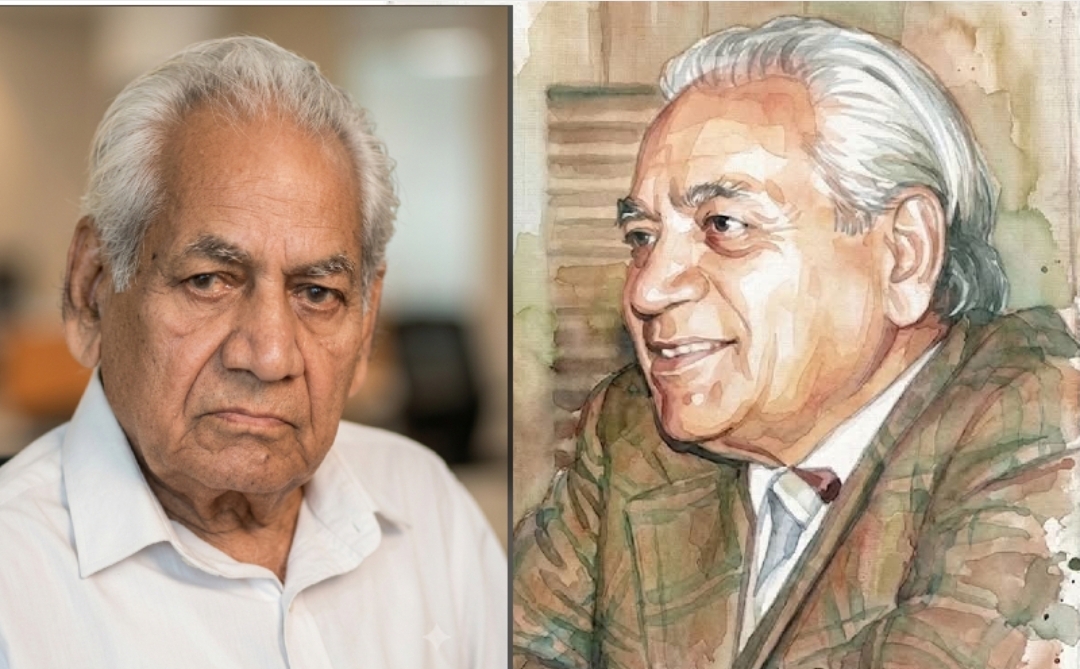
History carves certain poets out of its own wounds. Alongside their words, they carry the dust of their era, the tears of the people, the voices of those separated, and the melancholy of fading seasons. Ahmad Rahi was one such poet; for him, poetry was both a lamentation of life and a dialogue with it. September 2 marks the anniversary of Ahmad Rahi’s passing, with his 24th death anniversary being observed today.
Born in 1923 in the soil of Amritsar, this child grew up to become a distinguished name in Punjabi poetry a name whose words bore the fragrance of Punjab and the blood of its history. His real name was Ghulam Ahmad, but he chose “Ahmad Rahi” for himself. Rahi means “traveler,” and perhaps even he did not know that this name would become the defining metaphor for his entire life.
He was truly a traveler: from Amritsar to Lahore, from poetry to cinema, from love to deprivation, from fame to seclusion, and from memory into history.
His childhood and youth were spent in Amritsar during a time when the streets of the subcontinent echoed with calls for politics, freedom, and cultural awakening. In this environment, he crossed paths with figures like Saadat Hasan Manto, Saifuddin Saif, and A. Hameed.
It is no small thing that a single city, era, and educational atmosphere brought together people who would leave such deep imprints on Urdu, Punjabi, and South Asian literary history. However, due to political activities, he had to leave his studies behind. When the path to education closed, life offered another route: he joined his father in business. Yet how long could a man carrying the fire of words inside him weigh his dreams on the scales of the marketplace?
Then came the Partition of the country. This division was not merely of land, but of human beings, homes, relationships, memories, and dreams. Ahmad Rahi did not read about this tragedy in history books; he witnessed it with his own eyes and endured it in his soul. Perhaps that is why migration in his poetry transforms into a deeply human tragedy. When his collection Trijan was published, a fresh voice resonated across the landscape of Punjabi poetry.
Through Trijan, Ahmad Rahi proved that the delicacy of a language lies less in its vocabulary and more in the depth of its emotion. In Trijan, the grief of Partition riots emerged through the anguish of a woman—a woman for whom no bridegroom came, nor did a brother arrive to carry her palanquin. Her existence was stripped away in the riots, and her pain found no entry in any official document. He laments the desolation of Punjab’s land and the helplessness of womanhood:
کِیویں کتّاں کِیویں تُماں درداں والیے مائے
اج ترنجنی پھوڑیاں وِچھیاں
چُوڑے دے چھنکارے
لُٹ لے گئے ونجارے
The great triumph of his poetry lies in transforming collective tragedy into personal sorrow, and personal sorrow into a shared human feeling.
Another interesting aspect of Trijan is tied to Saadat Hasan Manto. At Rahi’s request, Manto wrote the flap text for the collection in Punjabi, making it a vital and memorable reference for Manto’s Punjabi prose. Ahmad Rahi’s son, Salman, mentioned that Manto was the son of Rahi’s paternal uncle. Thus, they were cousins, friends, writers in two different languages, and victims of a history that wounded both in its own way. Ahmad Rahi was also a poet of the silver screen.
Manto’s insistence and companionship led him to the film industry. His cinematic journey began with the film Beli, written by Manto and directed by Masood Parvez. Later, Ahmad Rahi wrote stories, dialogues, screenplays, and lyrics for both Punjabi and Urdu films, though his true fame stemmed from his songs. Into these lyrics, he poured the dialect of Punjab, the scent of the soil, a woman’s longing, the pain of separation, the restlessness of love, and the vibrant colors of rural life.
Whether it was the songs for the film Heer Ranjha or tracks from other movies, when Rahi’s words met music, they became the heartbeat of Punjab. When his masterpiece echoed in the voice of Malika-e-Tarrannum Noor Jehan, it touched every heartstring:
سن ونجھلی دی مٹھڑی تان وے
میں توں ہو ہو گئی قربان وے
Rahi’s songs appear simple on the surface, but once they enter the heart, they linger for a long time—the hallmark of a truly great lyricist. The song rendered by singer Afshan, penned by Ahmad Rahi, beautifully captures the rustic charm of Punjab and the restless state born from longing for a lost beloved:
رُکھ ڈولدے تے اکھ نہیں لگدی
نِمی نِمی واء وگدی
سانوں ٹھگ گئی یاد اک ٹھگ دی
نِمی نِمی واء وگدی
Fame never forced Ahmad Rahi to bow down. He belonged to those who could make art their livelihood, but would never humiliate their art for the sake of a living. Despite writing hundreds of memorable songs, he never knocked on the doors of film producers to beg for work.
As the film industry began to change topics shifted, tastes altered, and a superficiality entered cinematic sensibilities Ahmad Rahi could not accept it, and he gradually distanced himself. In the final years of his life, a tragedy deepened his solitude: a fire at his home consumed his literary archive and personal belongings. When a poet watches his papers, books, and memories burn to ashes, he feels as though the most precious years of his life have turned to dust. Already exhausted from within, he withdrew entirely into seclusion after the incident.
When Parveen Malik asked him in an interview about the colors of his past life, he offered a brief response: “It just passed… what is there to think about now?” Reading this sentence feels as though an entire autobiography has been condensed into just a few words. What all had passed? Amritsar had passed, childhood had passed, friends were lost, and Partition had passed.
Lahore came, Trijan was published, and the glamour of cinema passed. Countless songs graced the lips of the people, fame arrived, and then fame too passed away. Friends diminished one by one, until finally, the poet retreated deep within himself. On September 2, 2002, Ahmad Rahi’s journey came to an end. But do travelers ever truly end? They continue to walk through their words.
Even today, when an old film plays and one of his songs unexpectedly knocks on the door of the heart, one realizes that Ahmad Rahi has not died. He lives on in the faint voice of a radio, in an aging memory, in a classic tale of love, in the eye of someone parting ways, and in the silence of a mother.
Ahmad Rahi wrote magnificent songs and gave modern Punjabi poetry a new direction. He gave voice to those emotions of Punjab that rarely find a place in grand historical narratives. He heard the sorrow of women, understood the defeat of the lover, felt the wound of migration, and preserved the ache of human beings separated from their native soil. Ahmad Rahi was not just a poet; he was a witness to his era who not only observed history but felt it deeply.
Certain voices do not fade with time; rather, time makes them resonate even deeper. Ahmad Rahi is one such voice who, though gone himself, left his words behind for us. Today, those words are his home, and as long as Punjabi is spoken, a lamp will remain lit inside that home.
 Written By : Shahzad Framosh I Lahore