Pakistan’s cultural landscape is a rich tapestry woven from the contributions of poets, artists, musicians, and thinkers who have shaped the nation’s identity. While political history often dominates the narrative, it is the cultural figures who have given Pakistan its soul.
Among them, three stand out as transformative forces: Allama Muhammad Iqbal, the poet-philosopher who envisioned a separate homeland; Sadequain, the painter who redefined visual art in South Asia; and Faiz Ahmed Faiz, whose revolutionary poetry continues to inspire movements for justice.
Allama Muhammad Iqbal: The Visionary
Allama Muhammad Iqbal (1877–1938) is more than a poet—he is the intellectual architect of Pakistan. His philosophical poetry, written in Persian and Urdu, explored themes of selfhood, spirituality, and revival of Islamic civilization. Works like Asrar-e-Khudi (Secrets of the Self) and Payam-e-Mashriq (Message of the East) challenged Muslims to awaken from intellectual stagnation.
Iqbal’s 1930 Allahabad Address is considered a watershed moment, articulating the need for a separate Muslim state in the subcontinent. While he did not live to see Pakistan’s creation, his vision became the ideological bedrock of the nation.
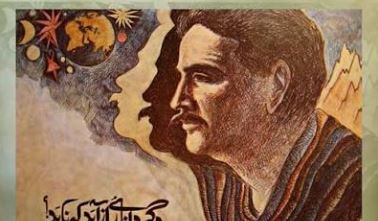
His verses, such as “Khudi ko kar buland itna” (Elevate your selfhood so high), remain etched in Pakistan’s collective consciousness, recited in schools, political rallies, and everyday life. Iqbal is not merely a historical figure; he is a living presence in Pakistan’s cultural DNA.
Sadequain: The Master Calligrapher
Sadequain Ahmed Naqvi (1930–1987), known simply as Sadequain, is perhaps Pakistan’s most celebrated visual artist. Unlike many of his contemporaries who embraced Western styles, Sadequain fused classical Mughal miniature traditions with bold, modernist expression. His signature style calligraphic strokes interwoven with figurative imagery created a visual language uniquely Pakistani.
His monumental murals, such as those at the Lahore Museum and Frere Hall in Karachi, are national treasures. Sadequain was also a prolific illustrator, bringing to life the poetry of Iqbal and Faiz through his pen-and-ink drawings.
He received all four of Pakistan’s highest civilian awards, a feat unmatched by any other artist. Beyond his technical brilliance, Sadequain was a philosopher who believed art should serve society, often depicting the struggles of the working class and the hypocrisy of the powerful.
Faiz Ahmed Faiz: The Poet of Resistance
Faiz Ahmed Faiz (1911–1984) transformed Urdu poetry by infusing it with political consciousness. While classical Urdu poetry often dwelt on love and mysticism, Faiz introduced themes of social justice, oppression, and hope. His collection Naqsh-e-Faryadi (Imprint of Complaint), published in 1941, established him as a major literary voice.
Faiz’s life was as compelling as his poetry. A progressive intellectual and Marxist, he was imprisoned in the 1950s for his alleged involvement in a coup attempt. Yet, even in captivity, his pen remained unstoppable. His poem “Mujh se pehli si mohabbat” (Do not ask me for that love again) is one of the most beloved Urdu verses, balancing personal longing with political despair.
Faiz’s influence extends beyond Pakistan his works are read across South Asia and the Middle East, and his commitment to human dignity continues to resonate with activists and artists worldwide.
Conclusion
These three figures Iqbal, Sadequain, and Faiz represent different dimensions of Pakistan’s cultural identity: intellectual vision, artistic innovation, and social conscience. Their legacies are not confined to museums or textbooks; they live in the poetry recited at gatherings, the art displayed in public spaces, and the songs sung by the people.
In a country often defined by its political turmoil, these cultural icons remind us of Pakistan’s enduring creative spirit and its capacity for profound human expression.
Writer’s Introduction: Ms. Sumra Farooq is an educator and writer with 20 years of experience. She can be reached at biyazdomain21@gmail.com.