Organizations are traditionally judged by their tangible assets: strategy, technology, governance structures, and financial yields. Yet, these represent merely the visible surface of an enterprise. A more fundamental question lies beneath: Who are the individuals making the decisions, exercising authority, and translating values into daily practice?
The most resilient institutions are not forged by systems alone. They are established when individuals of high capability and deep character build systems capable of outlasting them.
Modern management literature has long acknowledged this relationship. Jim Collins (Good to Great) emphasizes getting the right people on the bus; Stephen Covey (The 7 Habits of Highly Effective People) places character and competence at the core of personal effectiveness; and institutional theorists underline the primacy of governance and incentives.
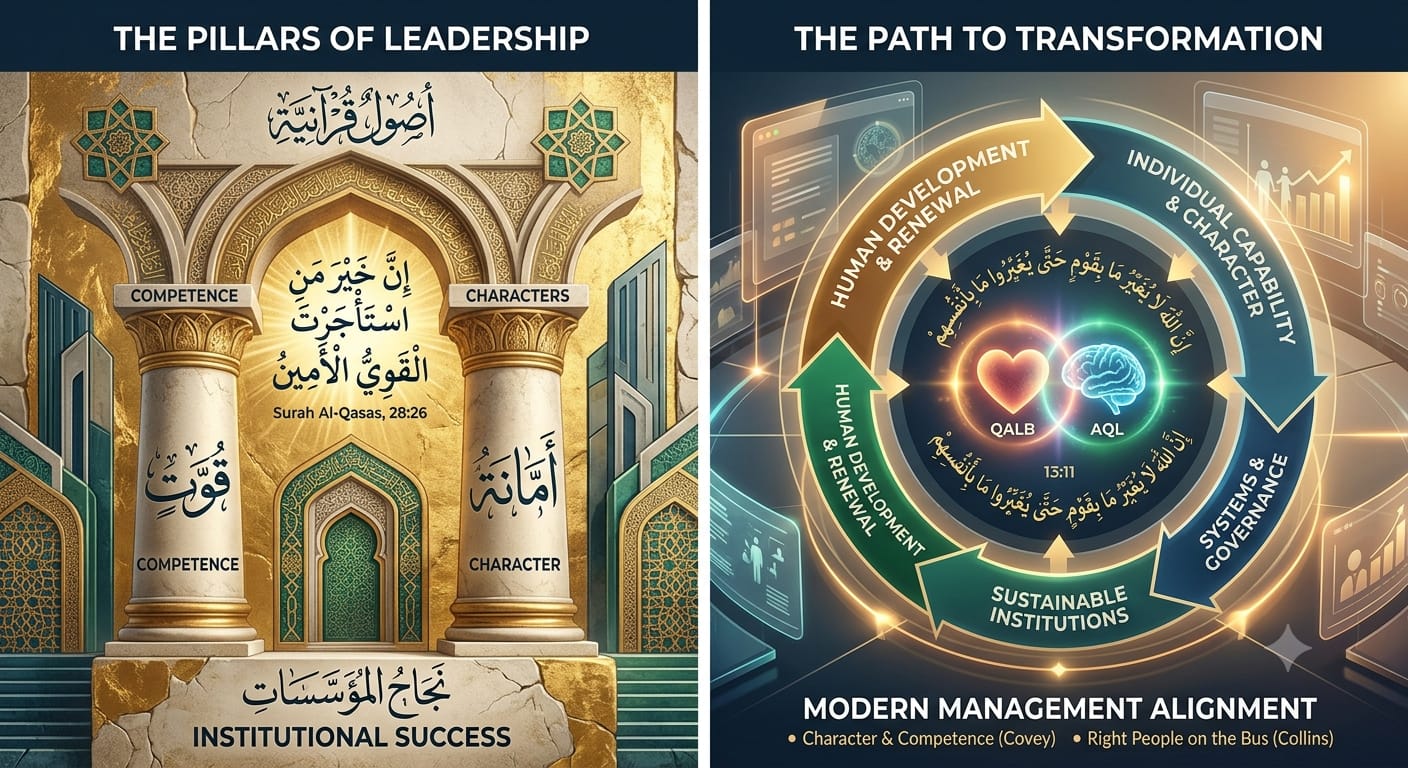
Together, they illustrate a continuous cycle: people build systems, systems shape institutions, and institutions, in turn,shape people, as explained in the model below.
However, the Qur’an deepens this perspective, anchoring organizational change in human transformation:
“Indeed, Allah does not change the condition of a people until they change what is within themselves.” (13:11)
This reveals a crucial truth: sustainable institutional transformation cannot begin with external structures alone. It must originate within the human heart and mind.
The Qur’anic criterion for key responsibility is remarkably precise. In the story of Prophet Musa (AS), two distinct qualities are highlighted for selection:
“Indeed, the best one you can hire is the strong and the trustworthy.” (28:26) Translated into contemporary boardrooms, these two qualities define the twin pillars of executive leadership: Competence and Character.
Competence without character creates strategic risk and systemic erosion. Character without competence leads to operational stagnation and execution failure.Institutions require both in equal measure.
Human development is not about uniform standardization. The Prophetic model demonstrates
how to align individual strengths with specific responsibilities matching distinct talents to
stewardship, governance, education, and diplomacy.
This mandates a fundamental shift in leadership philosophy. Rather than asking only, “What
system should we implement?” executive leaders must ask: “What kind of human beings will this
system develop, trust, and empower?”
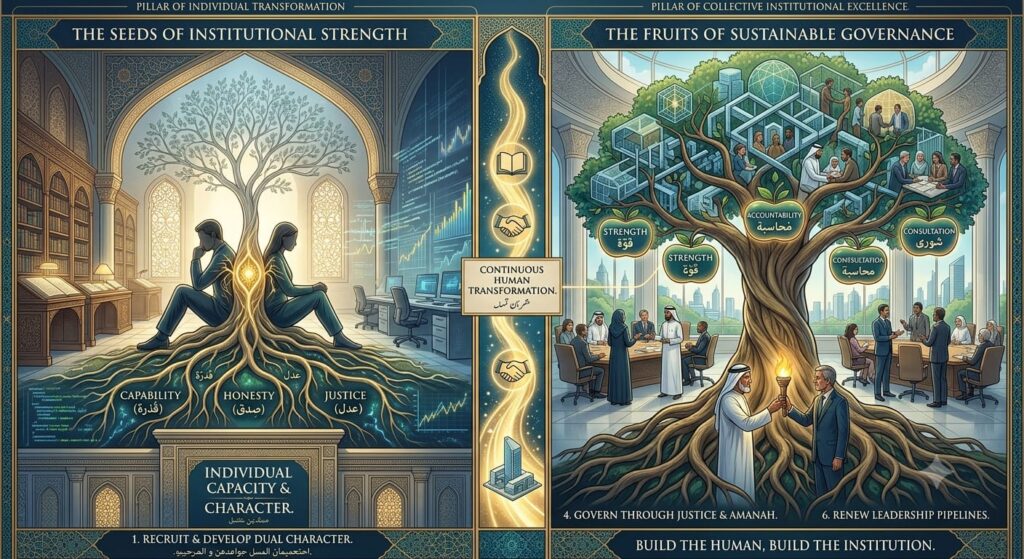
To achieve lasting institutional health, organizations must commit to six operational disciplines:
- Recruit for dual capability and character.
- Develop people beyond mere technical proficiency.
- Align individual strengths with organizational purpose.
- Govern through justice, Amanah (stewardship), accountability, and Shura (consultative
decision-making). - Measure both short-term performance and long-term organizational health.
- Renew leadership pipelines to secure the future.
An institution’s true test is not what it achieves during a founder or CEO’s tenure, but whether it
cultivates a pipeline of capable, trustworthy leaders to carry its mission forward. Build the human
being, and you build the institution; build the institution well, and it will build better human beings.
This continuous cycle of human transformation is the ultimate measure of sustainable
leadership.
 Written By : Tariq Saeed Chudhary