
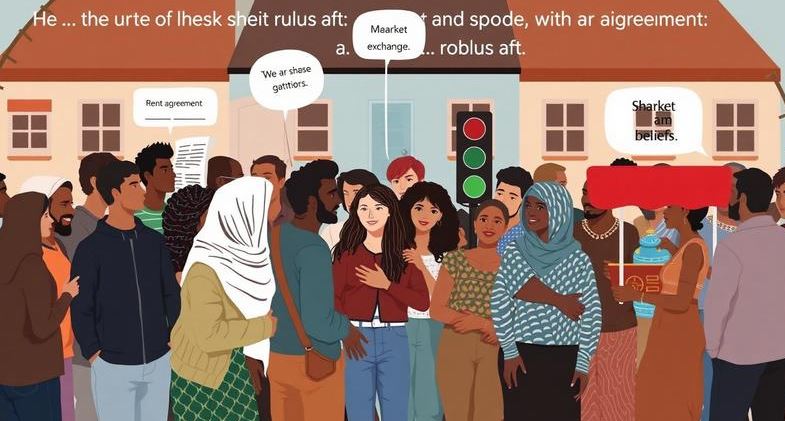
“Mutual co-existence” breaks down if you define it as ‘everyone agrees, no friction, no conflict.’ That is idealistic. Humans have competing needs, values, and limits. Erase that and you erase what makes us human. Where it becomes practical is when you shift the definition:
Co-existence ≠ agreement, the key switch that makes the whole idea practical.You can coexist with people whose worldview you fundamentally disagree with. If co-existence meant agreement, then you’d need:
Shared beliefs about morality and purpose
Shared view of history and identity
Shared priorities for family and education
That would be asking people to become the same. Forcing to agree is either assimilation or coercion, not co-existence. So what co-existence actually requires? It only needs agreement on the overlap the set of rules for shared space.
Think of it like roommates with different lifestyles: you don’t need to agree on what to watch, eat or believe, but you do need to agree on rent, quiet hours, cleaning the kitchen, not touching other’s stuff. If those rules hold, you can live together for years while disagreeing on everything else. Break those rules, and the framework collapses.
Markets do this constantly. A Muslim shop owner and a secular customer coexist because both agree on price, property and contract. They don’t need to agree on theology for the transaction to work.
You and I might disagree on politics, but we both stop at red traffic lights. We agree on the rule for that 30-second overlap. After that, we go our separate ways. We’re wired to want harmony to feel like agreement.
Silence + politeness gets mistaken for shared values. But that’s fragile. As soon as a real decision comes up – school curriculum, marriage law, land use the difference shows up. Practical co-existence is honest about that difference. If the state, workplace, or community tries to regulate belief, identity, and morality directly, you’re no longer in ‘co-existence’ territory; you’re in ‘conformity’ territory.
So co-existence is about managing disagreement in public space, not eliminating it. Where it worked for centuries: The Ottoman millet system that granted recognized religious minorities a significant self-rule to manage internal affairs like marriage, education, collect taxes.
This unique model of non-territorial autonomy functioned as the state handled defense and trade. Modern UAE: Shariah for Muslims in family laws, civil laws for others, foreign communities live by their own norms in private. Shared rules for business and public order. Both maybe imperfect, but they function because they don’t demand ideological unity.
It works at the level of action, not identity. You can’t force mutual co-existence in identity and belief without coercion. You can however, force it in behaviour and shared space. Laws, contracts and norms do this.
‘You can believe X, but you can’t act in way Y that harms me’ is the practical version. Bounded pluralism means: You can live by your values in your sphere, and I live by mine in mine. We don’t force the other to change. That’s why pluralistic societies don’t ban belief, they regulate action. So where does it fail? It becomes idealistic when it demands:
Emotional alignment form everyone
Silence on real disagreement
One side to bear the cost of tolerance
That collapses because it ignores human nature; people resent carrying burdens that aren’t theirs. It breaks down when either side believes their system must be total. At the level of shared rules, limited expectations, and bounded interaction, it is surely possible. It gets too idealistic only if you expect harmony without disagreement.
The Qur’anic framing is closer to practical: lakum deenukum wa liya deen – “to your religion, to me mine.” Co-existence is built on recognizing difference, not erasing it. Practical co-existence needs a truce on that point: the state protects basic rights and public order, but doesn’t enforce either group’s worldview on the other.
There’s a cost both sides are willing to pay. Co-existence isn’t free. It costs you the ability to fully implement your values in public life. If Group A isn’t willing to accept that Group B can live differently right next to them, you get civil cold war. If Group B isn’t willing to accept that Group A’s public expressions and institutions reflect their values, same problem arises.
The practical version looks like Switzerland, Lebanon pre-1975: before the outbreak of the civil war in 1975, Lebanon was widely celebrated as the ‘Switzerland of the Middle East’.
Both nations thrived on banking secrecy, tourism, and a highly diverse populace, but Lebanon’s delicate sectarian balance ultimately could not withstand mounting geopolitical pressures. Likewise, if we talk about parts of medieval Al-Andalus: separate communities, and shared institutions for trade & security, where communities prayed and governed themselves separately, but they intermingled daily in commercial hubs.
Just as Lebanon’s internal balance fractured under external pressures, Al-Andalus’s convivencia (coexistence) eventually buckled under geopolitical shifts ending this era of pragmatism, replacing shared institutions with strict polarization.
Pak-India Partition 1947, presently Palestine-Israel conflict, Kashmir struggle – all these show exactly why ‘mutual co-existence’ gets messy when core values + land + identity all collide. For Pak-India partition what made co-existence fail pre-1947:
Both groups increasingly saw themselves as separate nations, not just distinct communities. ‘Two-nation theory’ vs. ‘composite nationalism’ left no middle ground for shared political identity. The Muslim League argued that Congress’s vision of ‘composite nationalism’ meant Muslim interests would always be outvoted in a democracy. To them, staying united without safeguards was majoritarian rule in disguise.
If the disagreement was over tax rates or federalism, it may be conceded. But in such a case compromise looked like betrayal to both sides. Partition was the acknowledgement that bounded pluralism had failed.
The British exit removed the external structure that had been keeping the rules enforced. Migration coupled with violence was on the go; there couldn’t be stable pluralism when millions were being displaced and killed.
Separation was the outcome when co-existence was not possible. Partition worked as a divorce when marriage became unworkable. But it hasn’t solved the problem for minorities left on the other side, and it doesn’t address shared resources like water, Kashmir, ecology and environment.
Talking about Palestine-Israel conflict, gets harder because both sides claim the same land as non-negotiable, tied to core identity and theology. Standard co-existence models fail here because there isn’t even agreement on what constitutes public order, or who gets citizenship and rights. One side’s security is the other’s dispossession.
The conflict is over the same territory and institutions where compromise feels like betrayal, not pragmatism. It functions as neither co-existence nor clean separation.
The historical record shows co-existence only holds when:
There’s a clear separation of spheres, or
There’s a strong external arbiter both sides accept, or
One side wins decisively and the other accommodates.
Co-existence needs a minimum consensus on public order. The Palestine-Israel conflict shows what happens when there’s no agreed floor to stand on, a decades-long struggle for land, security and self-determination. The dispute remains one of the world’s most enduring and heavily contested geopolitical and humanitarian crises.
Lastly, deliberating on the challenges in Kashmir, it again fits the same pattern – co-existence ≠ agreement framework; the dispute is over sovereignty and identity. Co-existence becomes possible if you shrink the scope to what’s actually shareable presently:
Basic public order and security for civilians on all sides.
Trade, movement, and communication where feasible.
Protection of rights for people regardless of which administration they’re under.
That’s what the 2003-2007 ceasefire and Cross-LoC period showed, day-to-day life improved even though the sovereignty question didn’t move. It keeps failing because the overlap keeps getting expanded back into identity questions. Demographic changes, legal status amendments, and security measures are seen as existential threats. Silence is demanded on one side to keep peace, which breeds resentment.
The practical question arises: What minimum rules can both sides tolerate, even while disagreeing on sovereignty? That’s not a solution to the dispute though. But it’s the condition under which people stop carrying burdens that aren’t theirs at least – i.e. stop being treated as proxies for a sovereignty fight in daily life.
Taking everything into account, co-existence without agreement is possible at the level of action and shared rules, but breaks when either side tries to force agreement or identity and ownership. It isn’t a failure of people to tolerate each other; it’s a failure to separate the non-negotiable from the negotiable.
 By Sana Shoaib I The writer is a published author, former teacher and a freelance contributor. She can be reached at sanamujahid6@gmail.com.