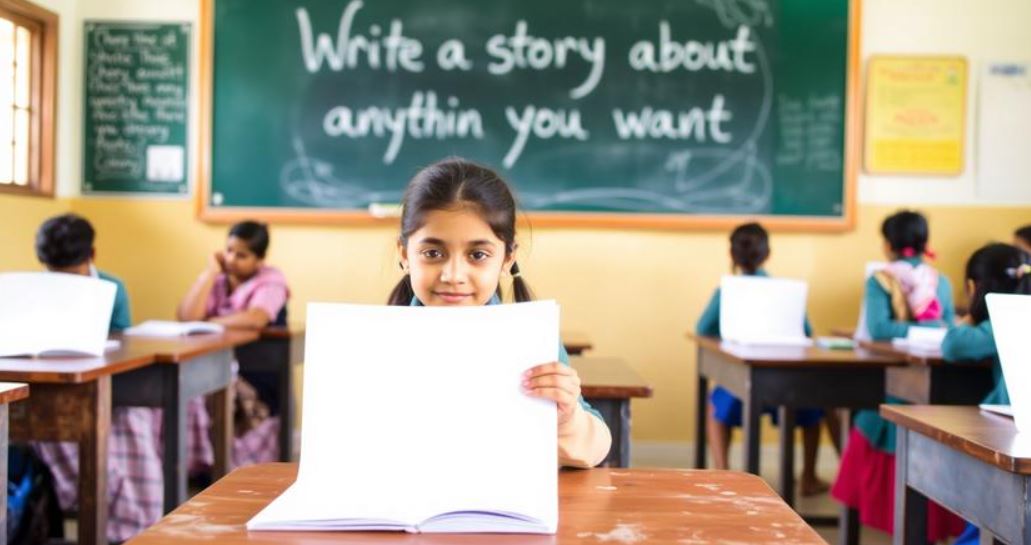
In a bustling classroom in the heart of Karachi, twelve year old Ayesha stares at a blank page. The prompt on the chalkboard is deceptively simple: “Write a story about anything you want.” An hour later, the page remains empty.
It is not for a lack of imagination,Ayesha dreams of talking moons and hidden valleys but because she has never been granted the permission to use it. She has successfully memorized three paragraphs on “My Best Friend” and two on “Quaid-e-Azam,” yet the concept of crafting an original narrative remains as foreign as a distant tongue.
Ayesha’s paralysis is no anomaly; it is a symptom of a quiet crisis. Creative writing, the heartbeat of critical thought and emotional intelligence, is facing a slow death in Pakistani classrooms. This decline is shaping a generation of students who can recite but not imagine, who can solve but not question.
Pakistan’s educational framework spanning both the Matric and Cambridge systems consistently strips “English expression” of its soul. From grade one through twelve, students are drilled in rigid formats: applications for leave, letters to the editor, and standard paragraphs on “A Visit to the Zoo.”
The creative story, the free-verse poem, or the mysterious diary entry are treated as extracurricular luxuries at best, and distractions at worst.
In a 2021 survey of 500 secondary school teachers across the country, over 80% admitted they never assign creative writing. The reason is pragmatic and cold: “It won’t be on the board exam.” The final assessment rewards the reproduction of pre-fabricated templates.
A student who pens a beautifully flawed story about loss will almost certainly score lower than one who flawlessly regurgitates an essay on the “Responsibilities of a Student.”
This environment thrives because Pakistani classrooms largely operate on a binary of correct versus incorrect. Creative writing, which thrives on ambiguity and has no “right” answers, terrifies both students and teachers alike. Having spent years training children to fear the red pen, the system cannot suddenly ask for vulnerability.
A student scolded for an irregular verb is unlikely to risk an unconventional plot twist. Consequently, by the time students reach O-Levels or Matric, many genuinely believe they lack creativity. But creativity much like Urdu calligraphy or cricket is a skill that withers from disuse rather than absence.
The irony is sharp. Pakistan possesses one of the world’s richest storytelling traditions, from Dastangoi to the folk epics of Saif-ul-Muluk. Yet, English classrooms often view creative writing as a frivolous Western import.
Urdu classrooms fare little better; writing is frequently reduced to mazmoon nigari (essay writing) or shairi (poetry) bound by rigid meter. The result is a student body fluent in copying but mute in speaking their own truths.
The death of the “verse” carries costs far beyond grades. Research suggests that narrative writing develops empathy and emotional regulation. Without it, the system produces graduates who can analyze iambic pentameter but cannot write a cover letter that sounds human, or quote Allama Iqbal’s Khudi without being able to articulate their own identity.
Despite the bleak landscape, small rebellions are blooming. In Lahore, teachers are dedicating ten minutes of “free writing” time where grammar is not graded. In Gilgit, a “Folktale Revival Project” encourages students to write new endings to ancient stories.
To let creative writing breathe again, experts suggest urgent examination reform, prioritizing process over product, and creating low-stakes platforms like wall magazines to celebrate stories without judgment.
Imagine if Ayesha were asked not for a paragraph on “My School,” but for a dialogue between Karachi and Lahore, or a letter from her future self. Pakistan does not need more memorizers.
It needs dreamers who can argue and leaders who can imagine futures invisible on any current syllabus. Creative writing is not a luxury; it is the forge of the critical mind. It is time to let it live again.
Sumra Farooq I An accomplished educator and writer, she is currently the English Subject Lead at a renowned institution Beaconhouse School System. With 20 years of rich experience in education and professional writing. Reader can be reached at biyazdomain21@gmail.com