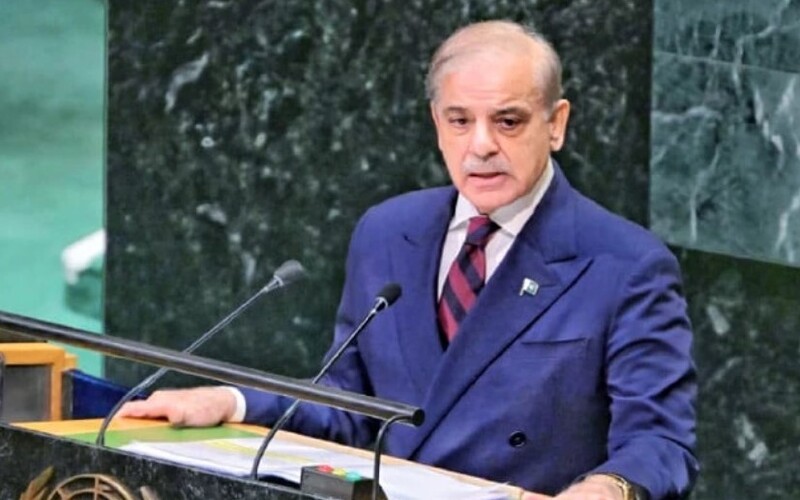
UNITED NATIONS: Prime Minister Shehbaz Sharif called on Friday for renewed diplomacy to end growing conflicts in the Middle East. He also warned India that any attempt to stop or divert Pakistan’s share of river water would be treated as an act of war.
Speaking at the 81st session of the United Nations General Assembly, Sharif urged world leaders to choose diplomacy over conflict.“We live at a dangerous moment. But our future is not already decided,” he said.
“War is a choice. Peace is also a choice. Sometimes, the greater courage is not starting a war, but preventing one,” he said. “Pakistan has chosen dialogue over confrontation, cooperation over pressure, and peace over war.”
Sharif spoke about conflicts in the Middle East, Palestine and Jammu and Kashmir, tensions with India, terrorism from Afghanistan, climate change, inequality, debt and reform of the United Nations.He began with a greeting and a verse from the Quran about peace. He also recalled Pakistan founder Muhammad Ali Jinnah’s support for the UN Charter.
Sharif said diplomacy must continue despite the fighting.Amid the roar of missiles, drones and guns, the voices for diplomacy must echo even louder,” he said.
He said Pakistan had worked to bring the United States and Iran to talks in Islamabad, which led to the signing of the Islamabad Memorandum of Understanding.
Sharif said the Strait of Hormuz and Bab el-Mandeb are important routes for the world economy and must remain open.
“These waters must carry the promise of prosperity, not the dangers of war,” he said.He condemned recent Houthi attacks on Saudi Arabia, including what he described as an attempted attack on Makkah. He said Pakistan stood with Saudi Arabia and that any threat to the holy sites of Makkah and Madinah was unacceptable.
Sharif said the Makkah Joint Defence Agreement between Pakistan, Saudi Arabia and Türkiye was not aimed at any country. He said it was meant to support defence, stability and peace in the region.
Sharif referred to last year’s conflict between Pakistan and India. He said Pakistan had acted in self-defence and praised its armed forces for their response.He also praised US President Donald Trump, saying his intervention helped prevent a much wider conflict between the two nuclear-armed countries.
Sharif said lasting peace in South Asia depended on resolving the Kashmir dispute. He said the people of Kashmir had waited for decades for the UN to hold a free and fair vote on their future.He accused India of detaining people, carrying out killings and disappearances, and trying to change Kashmir’s legal status and population.He said Pakistan would continue to support the Kashmiri people’s right to decide their future.
Sharif also opposed using water as a weapon. He called the Indus River system essential to Pakistan and said India had no legal basis for suspending the Indus Waters Treaty.“Water must never be weaponized. Rivers should nourish nations, not divide them,” he said.
He warned that any attempt by India to stop or divert Pakistan’s share of river water would be treated as an act of war.
“India must make no mistake about it,” he said.
Sharif spoke about the suffering of Palestinians and referred to children killed in Gaza, including Hind Rajab and eight-year-old Wafaa Akila.“Does not a child born in Gaza deserve the same life, the same future and the same dream as a child anywhere else in the world?” he asked.
He condemned the growing violence in the West Bank, Lebanon and Syria. He said the only lasting solution was an independent Palestinian state based on the pre-1967 borders, with Al-Quds Al-Sharif as its capital.
Sharif said Pakistan had lost nearly 100,000 civilians and members of its security forces in the fight against terrorism. He said the country had also suffered more than $150 billion in economic losses.He said groups such as the Tehrik-e-Taliban Pakistan and the Balochistan Liberation Army were using Afghan territory to carry out attacks in Pakistan.“This must come to a grinding halt,” he said.
He urged Afghanistan’s Taliban authorities to take clear and verifiable steps to stop Afghan territory from being used for attacks on Pakistan or other countries. He also called on them to protect the rights of Afghan people, especially women and girls.
Sharif said Pakistan produces less than one per cent of the world’s greenhouse gas emissions but faces severe effects of climate change. He urged richer countries to meet their climate funding promises and provide more support for recovery and preparation.
He also spoke about Pakistan’s role in UN peacekeeping and raised concern about Islamophobia, including attacks on mosques and the desecration of the Quran.
Sharif called for a stronger and fairer United Nations. He said the Security Council should better represent the world’s countries and be more accountable.“Reform for All, Privilege for None,” he said.
He ended by urging world leaders to choose peace and work together.“Let us restore trust. Let us preserve peace. And let us prove that, even in a divided world, humanity can still choose to stand together,” he said.
Reported By: Foreign Correspondent I United Nation