Before discussing law, justice, and citizen rights in any country, it is crucial to understand one fundamental reality: the difference between the State and the Government.In everyday conversation, we often use these two terms interchangeably, even though they hold entirely different constitutional and political positions.
State vs. Government: The Fundamental Difference
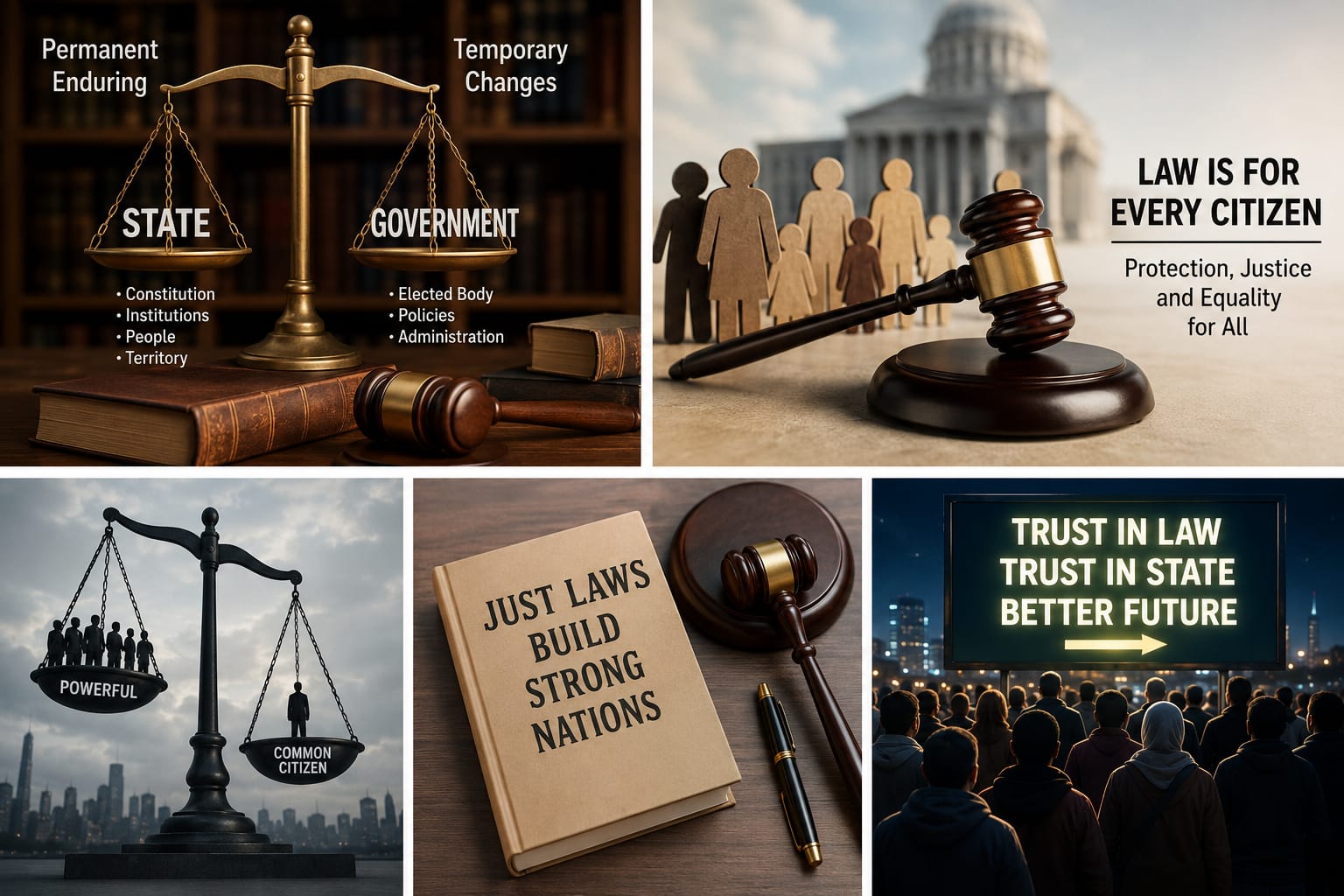
The State is a permanent and enduring system. It encompasses the country’s territory, its people, the constitution, courts, parliament, police, military, public institutions, and national sovereignty. Governments come and go, but the State remains intact with its identity, constitution, and institutions. The State is not the property of any single individual, party, or government; rather, it is a collective trust of the entire nation and all its citizens.
The Government, on the other hand, is a temporary body of individuals entrusted with the responsibility of running the affairs of the State for a designated term. A government is established through the people’s vote or constitutional procedures. Its duty is to enforce laws, provide services to the public, run state institutions according to the constitution, and improve national governance.
An Everyday Analogy:
Think of a large corporation. The corporation itself is the State, while its CEO, Board of Directors, and management represent the Government. If the CEO changes tomorrow, the company does not cease to exist; only the administration changes.
Similarly, a school building, its rules, teachers, and students remain constant, but the principal changes from time to time. Here, the school is the State and the principal is the
Government.
Therefore, criticizing a government’s policies is not enmity toward the State. Conversely, loyalty to the State does not mean unconditional support for a specific government or political party. A government is formed to serve the people, while the State is the shared trust of the people.
A good government is one that views itself not as the owner of the State, but as a servant of the people—upholding the constitution, applying the law equally to all, and prioritizing the delivery of justice.
Whom is the Law For?
Once this distinction is clear, another fundamental question arises: Whom is the law for?
The purpose of law is not to terrorize people, but to provide them with security. Laws are created to protect the life, property, honor, and freedom of every citizen—ensuring the weak receive justice, the powerful remain subordinate to the law, and peace prevails in society.
However, law is only effective when it is both respected and justly enforced. It is a universal truth: whoever chooses to live outside the law gradually loses the protection of the law.
If a citizen routinely evades taxes, gives or takes bribes, damages public property, violates the rights of others, or breaks the law for personal gain, they are not just breaking a rule—they are weakening the very foundations of their society and state.
Yet, when that same individual faces injustice, they expect justice and protection from the law.
If the law is only enforced against the weak while the powerful appear above it, if delays in justice become the norm, and if accountability is based on a person’s status rather than their actions, the public’s trust in the law begins to erode.The true power of law lies not in its punishment, but in the trust of the people.
The Wisdom of Political Thinkers
The relationship between the law, the state, and its citizens has long been explored by great minds:
| Philosopher ,Key Concept on Governance and Law
Thomas HobbesArgued that without law, society inevitably descends into chaos and anarchy. |
Jean-Jacques Rousseau Asserted that a government’s power is strictly conditional upon the consent of the governed. |
Max Weber Defined the State as the sole institution holding the legitimate right to exercise authority in accordance with the law.
Despite their different eras, these thinkers agreed on one core principle:
the purpose of government must be public service, and the purpose of law must be justice, not merely the preservation of power.
Just Laws vs. Tools of Control
How can an ordinary citizen distinguish between a law made for the public good and one designed merely to control them?
A Just Law: Applies equally to everyone, respects fundamental human rights, provides access to an independent judiciary, is transparent, and allows for peaceful dissent.
An Unjust Law: Is applied selectively, discriminates between citizens, lacks transparency, or serves primarily to protect the ruling elite’s power rather than the public interest. Questioning such laws is a natural and democratic right.
History teaches us that nations do not become strong simply by passing more laws; they become strong through the equal application of law. When the government is subordinate to the law, institutions are independent, and citizens fulfill their responsibilities, then justice, progress, economic stability, and national unity naturally follow.
The true strength of a state does not lie in its weapons, buildings, or treasury. It lies in the trust that citizens place in their constitution, their laws, and their institutions.
Questions for Self-Reflection
As citizens and as a nation, we must ask ourselves:
- Do we obey the law only out of fear of punishment, or because we genuinely believe in justice and the collective good?
- Is the government managing the trust of the State with honesty, or has it blurred the line between State and Government, mistaking itself for the State itself?
- Are we truly ready for a system where the law is equal for all, where no one is above the law, and where no one is deprived of its protection?
Perhaps the answers to these very questions will determine our path ahead: will we move toward a strong state, a just society, and the true rule of law, or will we distance ourselves from the law and find ourselves entirely deprived of security?Written By: Imran Haider