In February 2026, a devastating war broke out between the United States and Iran. During the conflict, several members of Iran’s senior leadership were killed, while Iran resisted with determination. The Iranian people stood firmly alongside their leadership, and both sides employed advanced military weaponry on a large scale.
The war claimed the lives of countless innocent civilians and caused widespread destruction of infrastructure. Both countries suffered enormous human and economic losses. The closure of the Strait of Hormuz disrupted global oil supplies, leading to severe shortages of food, medicines, and infant formula in many parts of the world. Transportation costs for buses, trains, taxis, and air travel rose sharply, triggering inflation and creating hardship for millions. As the conflict intensified, fears grew that it could escalate into a Third World War. There were also grave concerns that the use of nuclear weapons could result in catastrophic consequences for humanity.
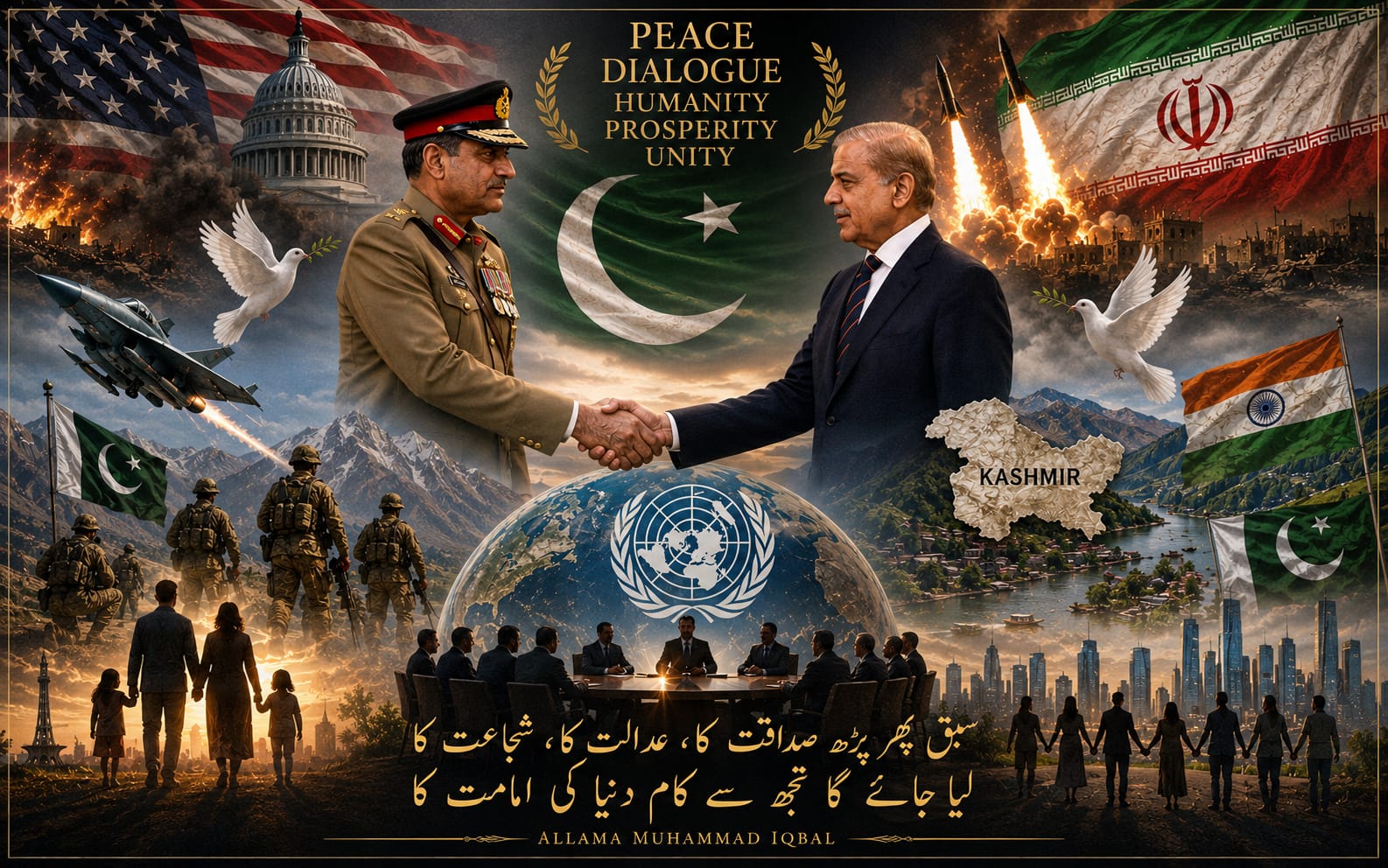
At this critical moment, Pakistan’s leadership stepped forward to help ease tensions. According to this account, Pakistan’s military leadership under Field Marshal Asim Munir and the country’s political leadership under Prime Minister Mian Shehbaz Sharif facilitated dialogue between the United States and Iran. Their diplomatic efforts reportedly contributed to a temporary ceasefire and opened the way for negotiations.
Subsequently, both countries presented their respective demands, and Pakistan continued to serve as an important bridge between them. After extensive negotiations, both sides reportedly reached an understanding, and by June 2026 the conflict came to an end. The world breathed a sigh of relief. In this narrative, Pakistan’s military and civilian leadership are praised for helping to end a dangerous conflict that could have threatened global peace.
These developments, according to the author’s perspective, enhanced Pakistan’s prestige and demonstrated its commitment to peace. The message conveyed was that Pakistan is a peace-loving nation that seeks friendly and peaceful relations with its neighbors, including India. However, the author argues that regional tensions have often been aggravated by India’s expansionist policies and recurring military confrontations.
The author further refers to the 2019 India-Pakistan crisis, stating that Pakistan defended its territory, shot down Indian aircraft, captured an Indian pilot, and later released him as a gesture of goodwill. According to the author, this reflected Pakistan’s desire for peace while also demonstrating its ability to defend itself.
The article also discusses the 2025 military confrontation between India and Pakistan, referring to India’s alleged “Operation Sindoor” and Pakistan’s response under “Operation Bunyan al-Marsous.” The author claims that Pakistan inflicted significant military losses, including the downing of Rafale fighter aircraft, after which a ceasefire was reached. The article argues that lasting peace between the two countries depends on resolving the Kashmir dispute in accordance with the wishes of the Kashmiri people.
The author concludes by urging the international community, human rights organizations, and the United Nations to encourage meaningful dialogue between India and Pakistan and to help find a peaceful and lasting solution to the Kashmir issue. Such a settlement, the author believes, would enable both countries to enjoy stability, prosperity, and economic development.
Finally, the author expresses the hope that Pakistan will continue to play a constructive leadership role in promoting peace and resolving international conflicts. In this context, the article concludes with the famous words of Allama Muhammad Iqbal:
“Learn once again the lessons of truth, justice, and courage; The world will one day call upon you to lead humanity.”
Note: The translation above preserves the author’s viewpoint. Some statements—particularly regarding military operations, diplomatic roles, and historical events—are presented as the author’s claims and should not be taken as independently verified facts. The content of Article is only responsible of Writer, Not ” The Guider