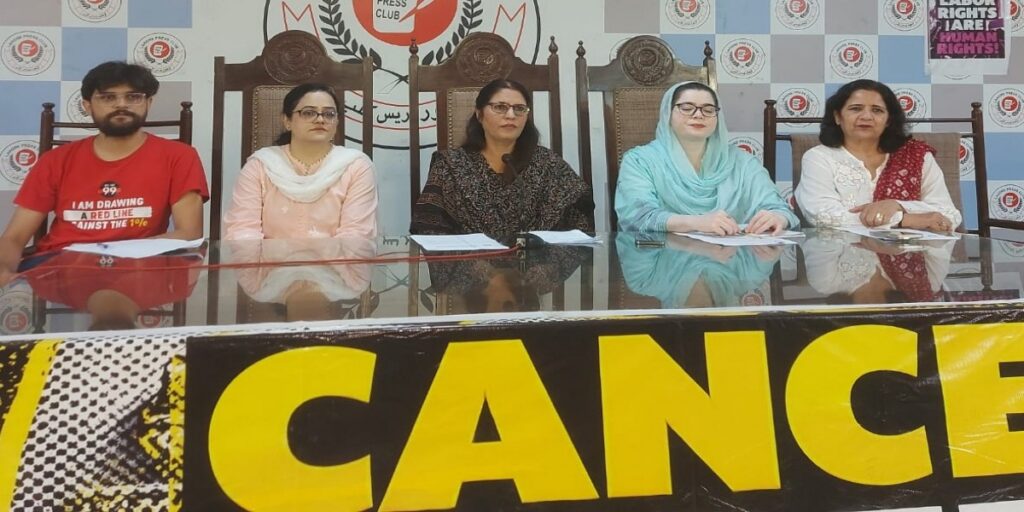
LAHORE: As the International Monetary Fund (IMF) and World Bank hold their Annual Meetings in Bangkok, Thailand, from 12 to 18 October 2026, the Pakistan Kissan Rabita Committee (PKRC), in collaboration with Tameer-e-Nau Women Workers Organisation (TWWO), organised a seminar at the Lahore Press Club on Friday, joining a global mobilisation demanding debt cancellation, an end to austerity policies, and climate justice for countries across the Global South.
The seminar brought together representatives of farmers’ movements, women’s organisations, human rights groups, trade unions and civil society to highlight the devastating consequences of mounting public debt, regressive taxation, rising living costs and austerity measures imposed on working people.
The gathering formed part of the Global Day of Action against the IMF and World Bank, which saw demonstrations and public actions in more than 60 cities across 23 countries. On 12 October, more than a thousand trade unionists, grassroots activists and international delegates marched through Bangkok, calling for fundamental reforms to the international financial system.
Speakers argued that Pakistan’s repeated dependence on IMF programmes has failed to deliver sustainable economic development or meaningful relief to ordinary citizens. Instead, the burden of economic adjustment continues to fall disproportionately on farmers, industrial workers, women and low-income households through rising electricity tariffs, indirect taxation, cuts in public expenditure and declining purchasing power.
Riffat Maqsood, Chairperson of Tameer-e-Nau Women Workers Organisation (TWWO), highlighted the disproportionate impact of austerity measures on working-class women.
“Whenever governments implement austerity measures, it is working women who pay the highest price. Rising electricity bills, food inflation and declining public services place enormous pressure on households, while women are expected to compensate through unpaid care work and additional labour.
At the same time, cuts in public spending undermine women’s access to healthcare, education and social protection. We demand economic policies that prioritise working people’s livelihoods rather than protecting the profits of corporations and financial institutions. Women’s economic rights and social protection must be at the centre of any discussion about development.”
Nazia Zahid, Programme Manager at Simorgh Women’s Resource and Publication Centre, Lahore, emphasised the relationship between debt, structural inequality and women’s economic marginalisation.
“The debt crisis is not simply a question of how much money Pakistan owes to international creditors. It is fundamentally a question of who bears the burden of repayment and whose interests economic policies serve. When governments prioritise debt servicing over education, healthcare and social welfare, they deepen existing inequalities, particularly those affecting women and marginalised communities.
Economic justice requires progressive taxation, stronger public institutions and democratic participation in decisions about public resources. Development cannot be considered successful when millions are pushed further into poverty while economic privileges remain concentrated among a small elite.”
Feroza Batool, Senior Programme Manager at the Human Rights Commission of Pakistan (HRCP). stressed that economic policies must be assessed through the framework of fundamental human rights.
“Access to food, healthcare, education, decent employment and social security are fundamental human rights, not privileges that can be withdrawn in the name of fiscal discipline.
Economic adjustment programmes that deepen poverty and inequality raise serious concerns about the state’s ability to fulfil its obligations to its citizens. Pakistan’s economic challenges must not become a justification for weakening labour protections, reducing essential public services or shifting the costs of economic crises onto vulnerable communities. Human rights and social justice must remain central to economic policymaking.”
Saima Zia, representing the Crofter Foundation, highlighted the devastating impact of debt and austerity on Pakistan’s rural communities.
“Pakistan’s farmers and rural communities are being pushed deeper into poverty by rising agricultural costs, climate disasters and economic policies that prioritise debt repayments over people’s livelihoods. While billions are spent servicing debts, small farmers struggle to access affordable inputs, fair crop prices and basic public services.
We demand debt cancellation, climate reparations and an economic system that protects farmers, ensures food sovereignty and puts people’s needs before corporate profits.”
Speakers also drew attention to the growing connection between Pakistan’s debt crisis and its vulnerability to climate change. Despite contributing only a small fraction of global greenhouse gas emissions, Pakistan continues to face devastating floods, extreme temperatures, agricultural losses and displacement.
Participants expressed solidarity with the thousands of activists, trade unionists, farmers and community organisations mobilising across Asia, Africa, Latin America and other regions against the prevailing international financial architecture.
They reiterated that the burden of Pakistan’s economic and climate crises must not be transferred to the people least responsible for creating them.
The seminar concluded with a call for a fundamental transformation of the global financial system towards one that prioritises human rights, ecological sustainability, economic sovereignty and the needs of working people over debt repayments and corporate profits.
Reported By: Staff Reporter I Lahore