LAHORE: The act of creation, in its ultimate form, is the quest for the right word. Ghalib is not a great poet merely because he mentioned Kolkata, the center of new enlightenment, but because he used the expression “Haye Haye” in a way that drives a piercing arrow straight into the reader’s heart:
Ghalib-e-khashta ke baghair kaun se kaam band hain
Roiye zar zar kya, kijiye haye haye kyun
Look at Shakespeare, how he turned “To be or not to be” into a treasure trove of meaning. In the line “Miyan khush raho hum dua kar chale,” Mir utilized an ordinary word like “Miyan” with such a tender, affectionate, dervish-like warmth.
A single word possesses so many multifaceted dimensions that it acquires the status of a whole universe of meaning within a poem or a sentence. Here, it is pertinent to mention Saadat Hasan Manto’s short story “Khol Do”.
These two words “Khol Do” (Open it) express an unconscious feeling lost in the deep and unfathomable darkness of human psychology.
Shahzad Framosh has fallen so deeply in love with the Punjabi language that at times he appears prejudiced, though perhaps calling him emotional would be more accurate. In his sole Punjabi writing, written as a flap for Ahmad Rahi’s “Trinjan”, Manto notes:
“Hearing the name ‘Trinjan’ evoked in my mind the image of a place I have never seen. Whenever anyone mentions a Trinjan, I feel a strange kind of joy.
It feels to me as if I am a girl sitting with her peers, spinning a charkha. Call it the magic of the atmosphere of Punjabi villages, or give it any other name.
This collection contains everything, from the trivial price of a damri to million-dollar businesses, and from the gleaming sparkle of a nose-ring to those stories charged with lightning.”
Shahzad Framosh is infatuated with this single Punjabi piece by Manto. Not only did he become an even greater admirer of Manto, but he also penned a splendid tribute to Ahmad Rahi with reference to his book of Punjabi poetry, “Trinjan”.
Through all his scholarly endeavors, Shahzad Faramosh has familiarized the Urdu-speaking girl with Waris Shah’s Heer, the village village-square (chaupal), the brinks of the village wells, and the charming language of individuals toiling in the ploughed fields and meadows.
This is the language expressed in the songs of weddings such as Waris Ludhianvi’s song, “Desan da raja mere babal da pyara, ambri da dil da sahara, ni veer mera ghori charhya” and in the masterpieces of songs and stories from Punjabi films by Hazin Qadri, Khawaja Pervez, Saifuddin Saif, and Ahmad Rahi.
Shahzad Framosh’s collection of Punjabi short stories, “Chup, Sah te Sufne” (Silence, Breath, and Dreams), contains twenty-one stories truly a 21-gun salute to the Punjabi language. Parveen Malik, Zahid Hasan, and Khalid Farhad Dhariwal have hailed him as a stylistic writer in their critiques of his fiction.
Another axis of Shahzad Framosh’s scholarly interest is the history of Lahore. He knows by heart all the literature written on the history of Lahore. He is intimately familiar with the balconies, streets, courtyards, and lattices of Lahore, narrating them with the flair of a master storyteller.
Walking down these paths, he tells us which prominent personalities once passed through, what lay behind a specific latticed window, how a certain educational institution was built, and how the historical red-light district of Heera Mandi came into existence.
In the near future, a monumental book of his about Lahore is also slated for publication; ongoing work on it will add yet another major feather to his cap.
After completing his education at FC College, Shahzad Framosh earned his Master’s degrees in both Urdu and Punjabi. However, a far greater achievement than his formal education is his mature intellect and profound knowledge, which he cultivated by rummaging through forgotten manuscripts tucked away in libraries.
Shahzad Framosh has never stood in line waiting for an honor or an award. For the Lahore Press Club library, he personally secured thousands of books from publishing houses, fully aware that the majority of journalists carry an endless list of personal needs rather than a book in their hands.
As a key member of the Lahore Press Club’s Cultural Committee, he invited countless notable personalities and preserved the stories of their life journeys, which audiences heard for the first time. He organized book fairs at the Press Club and single-handedly hosted a Punjabi Festival on Mother Language Day (Maa Boli Dihaad).
Shahzad Framosh’s intellectual journey, his services to Punjabi language and literature, and his devotion to friendship are unforgettable. On many occasions when my pockets were empty, he went out of his way to help me sell newly acquired or old books to second-hand book dealers.
He has not only provided a fictionalized fringe-art decoration to the persona of an average “Punjabi Lucknowi poet,” but has literally lifted the wreckage of his living body from his home, brought it to the Press Club, and whenever the poet wants to go anywhere from the club, Framosh readily climbs onto his motorcycle to serve him.
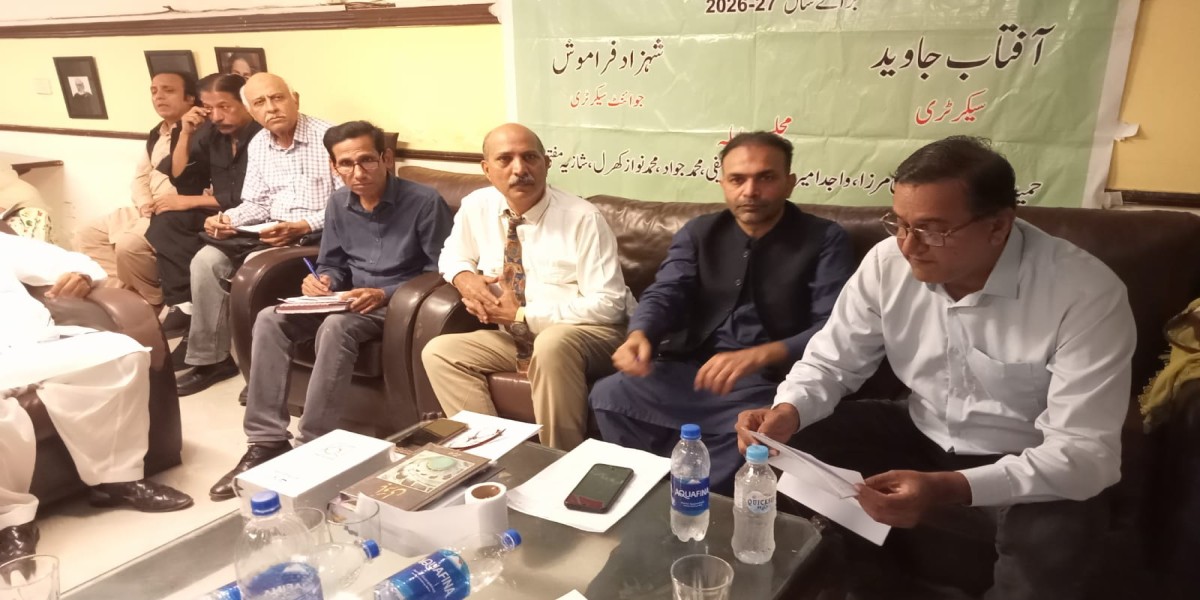
Shahzad Framosh is a life member of the Lahore Press Club and was unanimously elected as the Joint Secretary of the Halqa-e-Arbab-e-Zauq this year.
Bringing important figures to preside over multiple sessions is a testament to his hard work, and laboring to keep the torch of the Halqa’s evolving literary tradition burning bright is his newly embraced responsibility. Scholarly and historically, Shahzad Framosh steers the lost back onto the right path.
Though lost in a directionless crowd, he never forgets his responsibilities or his studies—and that is what makes him truly unique.
In Shahzad Framosh’s story “Kodi Diyan Cheekan” (Screams of Cowries), the discovery of words is executed splendidly.
Words like “Achhanchit, tor, tarawa, bela gaan, mangri, janana, kansra, banta ge” are embedded in his fiction like a precious gem set in a ring.
Stories like “Sab Mangte Ne, Ishq Di Kook, Okhe Pende, Kachi Matti Di Mehak, Mashina Vich Gawacha Banda, Virsiya Mukh” are invaluable additions to Punjabi fictional literature.
Students and researchers of the Punjabi language can witness in Shahzad Framosh’s stories a portrait of society that no one has depicted quite like this before.
As a researcher, Shahzad Framosh has presented the proper usage and nuances of Punjabi words in such a way that it feels as though he has reunited us with a forgotten concept and interpretation, much like meeting an old acquaintance.
I am always amazed by how intellectually affluent he is, possessing the capability to play a profoundly meaningful role in any institution, especially platforms dedicated to the Punjabi language and literature.
For a long time, the Punjabi Adabi Board has remained dysfunctional not merely due to grants, but because of unsuitable leadership.
Recently, when the Board was finally freed from the clutches of an elderly woman, it was handed over as some sort of bribe to another alluring beauty renowned for such maneuvers.
When a media group launched a Punjabi channel, everyone knew that Shahzad Framosh was not only the most suitable person for it, but also possessed the capability to make its utility and objectives far more effective than any Urdu channel. Yet, those who blocked his path were not his enemies, but his own friends.
Consequently, he refrained from seeking any recommendations or knocking on doors, as that has never been his way.
He is well aware of the current adulteration in Punjabi narrative literature that it is not part of the authentic story, but rather the handiwork of a few novices and mentally deficient individuals; yet, today, even errors commonly spoken have become part of the original tale.
In this regard, Heer Waris Shah is the greatest victim. Can the Punjab government benefit from Shahzad Framosh’s services, given that he possesses the art of separating the sand from the millet? But that is nothing more than a fool’s dream.
I can also shed light on other aspects of my friend’s scholarly and literary stature. He holds the caliber of a teacher and can enrich students of any Punjabi class with the etiquette of the Punjabi language far beyond the prescribed syllabus.
He could even serve as an exemplary Vice-Chancellor for any Punjabi university. Another significant facet of Shahzad Framosh’s interests is his passion for music. He has a complete command of the science of prosody (Ilm-e-Aruz) and thoroughly understands the composition of raags.
Although he did not take up singing as a regular profession, he is deeply familiar with all the major musicians and vocalists of subcontinental film music and is well-acquainted with their work. We can hear him play Mohammed Rafi, Manna Dey, and Kishore Kumar, and he can sometimes be seen humming Mukesh.
Najm Hossein Syed a teacher of the Punjabi language, poet, and playwright who is the author of over a hundred books has himself crossed the threshold of a century, standing today like a great banyan tree.
Just as poets and critics like Mushtaq Sufi and Abid Ameeq keep the nuances of the Punjabi language and its Sufi tradition alive under his shade, a magnificent portrait of Punjabi fiction equally exists in the stories of Shahzad Framosh.
He practically desires to see the Punjabi language shine across the entire world like a bright sun, much like the artists of Chardha Punjab.
He believes that amidst the labyrinth of national and official languages, Punjabi can only receive its due right when the proceedings of the provincial assembly in the largest province, Punjab, begin in Punjabi, and when Punjabi is not an optional subject in the curriculum, but a compulsory one where writing, reading, and speaking Punjabi are not symbols of humiliation, but marks of pride.
While reading Shahzad Framosh’s collection of short stories, I was reminded of the publication of the intellectual Aamir Riaz’s book on the history and language of the Punjab, “Punjab di Vel”, and its enthusiastic, immediate embrace, which is a testament to the allure of the Punjabi language.
I am also reminded of my highly respected friend Wajahat Masood’s poem, “Aje Walton Camp Nahi Mukya” (The Walton Camp Has Not Ended Yet). Perhaps the illumination that this poem sheds on our national, social, and cultural life is the ultimate question itself.
We hope that as long as Shahzad Faramosh’s pen keeps flowing, we will find answers to every question and be able to secure a better and brighter future for coming generations.
Shahzad Framosh currently holds a unique identity as a renowned personality. The journey of his personal pursuits and curiosity resembles the expansive skies and is characterized by a passion to dive into the depths of the oceans.
Even during his student years, he did not restrict himself to the curriculum; instead, he busied himself with searching for the origins of language and gaining awareness of the reality of art. His scholarship woven into poetry, fiction, the history of Lahore, and the fragrance of the Punjabi language has become the title of his life.
Though lost in this crowd, he is never neglectful of his work. He knows that every moment of life is precious and must never be wasted. The station where he stands today is what he considers his starting point; from here, he is poised to take a flight and carry his work and name to the vastness of the horizons.
His imagination and his quest walk hand in hand, and his pen is writing a new story that will truly become the distinct hallmark of Shahzad Framosh’s name. For his livelihood, he stepped into the desert sands of journalism, and even there he did not let his true identity be lost.
Alongside being a columnist, edition in-charge, and conducting interviews on TV programs, he has also served as the editor of the Punjabi literary magazine “Jannat” and “Sneha”, the journal of the Punjabi Adabi Sangat.
Many facets concerning Shahzad Framosh’s work and name still remain to be told, because his intellectual journey and his unconditional bond with the Punjabi language have not stopped yet.
Yeh masail-e-tasawwuf yeh tera bayan Ghalib
Tujhe hum wali samajhte jo na baada-khwar hota
These mystical matters, and this discourse of yours, O Ghalib! We would have considered you a saint, had you not been a wine-drinker.
Reported By: Tahir Asghar I Lahore