LAHORE: Pakistan Peoples Party leaders have said “Should we save politics or the country?” Therefore, the difficult decision to impose Governor’s Rule had to be taken. For us, the country and the people come first; politics comes later.
Although the summary was issued under the signature of the Peoples Party President, it was a constitutional requirement; the Peoples Party supported difficult and unpopular constitutional decisions by prioritizing the protection of the state and the public over political interests. Employment, business activities, and economic stability are inconceivable without law and order in the country.
Instead of making state affairs contingent upon the release of a single individual, the Tehreek-e-Insaf should focus on public issues, law and order, and unemployment.
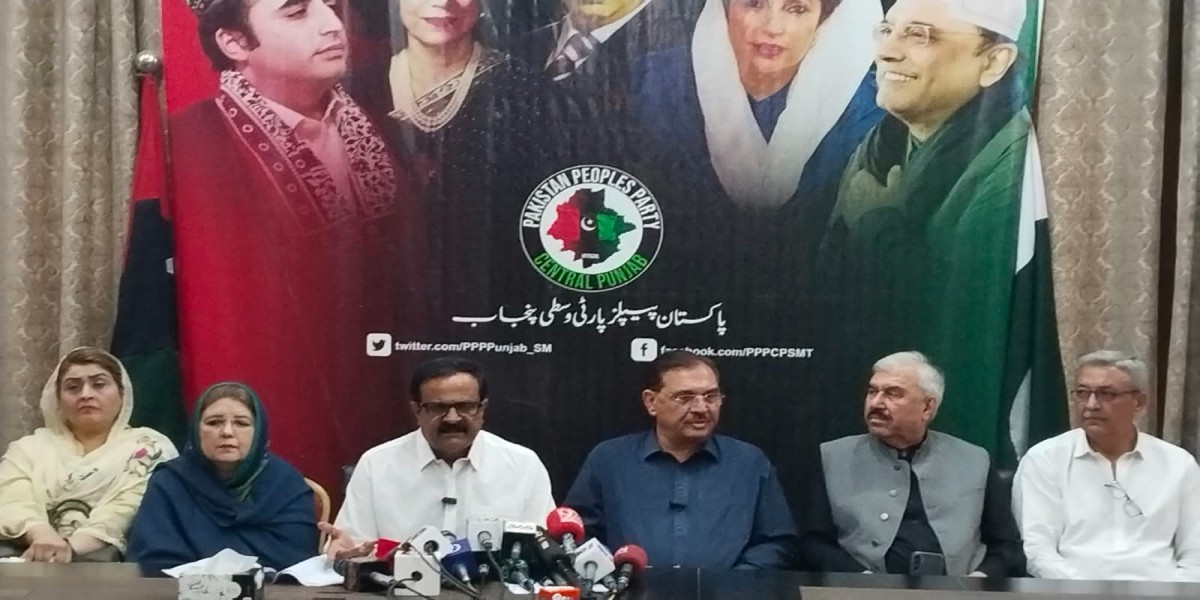
These views were expressed by Humayun Khan, Secretary General of the Pakistan Peoples Party, while addressing a press conference and answering media questions at the Peoples Secretariat in Model Town, alongside Syed Hassan Murtaza (General Secretary, PPP Central Punjab), Shahzad Saeed Cheema (Information Secretary), and Rana Farooq Saeed. Ahsan Rizvi, Ayesha Nawaz Chaudhry, Rao Babar Jameel, Asif Bashir Bhagat, Rubina Shaheen Wattoo, Chaudhry Akhtar, Faiza Malik, Ahmed Ghumman, Abdul Razzaq Salimi, Muneeba Makhdoom, and Chaudhry Riaz were also present on the occasion.
Humayun Khan stated that he had come to Punjab to discuss organizational matters; when faced with the choice of saving either the country or politics, the Peoples Party prioritized the country Pakistan and its people come first, while politics comes later. Syed Hassan Murtaza remarked that the Peoples Party had adopted the path of negotiation and dialogue to improve the situation; however, the circumstances became increasingly complex due to the lack of a positive response.
The government, in collaboration with security agencies, endeavored to normalize the situation and was compelled to take certain constitutional measures that were not politically palatable. He stated that the declaration issued under the President’s signature adhered to constitutional requirements, and the Peoples Party exercised its constitutional prerogative with a heavy heart, as prioritizing the state’s interest over political gain was essential.
He noted that the Peoples Party stood by the state despite incurring political costs, and he prayed that Allah Almighty protects Pakistan and its people from all manner of threats. He remarked that the imposition of Governor’s Rule is neither a matter of pride nor happiness for the Peoples Party; however, when the Chief Minister of Khyber Pakhtunkhwa is unwilling to engage in dialogue, considering alternative constitutional avenues becomes inevitable to improve the law-and-order situation in the province.
He questioned what measures should be taken to prevent a clash between state institutions when federal and provincial forces confront one another. Criticizing the Tehreek-e-Insaf, Syed Hassan Murtaza stated that had the party protested based on public issues, its stance would have been politically acknowledged; however, paralyzing the entire system to secure the release of a single individual is by no means appropriate conduct.
He observed that it is contradictory to stage protests for political objectives and then question why the state exercised its constitutional authority. He emphasized that the Peoples Party has presented the actual situation rather than resorting to pretexts, prioritizing the stability of the state despite political differences.
He further stated that answers are required regarding the law-and-order situation in Khyber Pakhtunkhwa, the movement of the public, and the policies of the provincial government. He added that there must also be a clarification regarding the provincial government’s move to extend an invitation to the Afghan government.
He questioned whether allowing the prevailing unrest and alleged “rule of thugs” in the province to continue was a better alternative than Governor’s Rule. He noted that the Pakistan People’s Party (PPP) took a month to decide on the matter of Governor’s Rule, attempting during that time to resolve the situation through political dialogue.
Syed Hassan Murtaza stated that the sacrifices made by Pakistan’s armed forces cannot be forgotten, and the nation pays tribute to its martyrs. He asked the leadership of the Tehreek-e-Insaf whether they had ever attempted to share in the grief of the affected families by attending the martyrs’ funerals.
He suggested asking the widows and orphans of the martyrs about the impact terrorism and unrest have had on their futures. He pointed out that the PPP has itself faced the imposition of Governor’s Rule against its government in the past and has also made sacrifices during periods of martial law.
Citing the sacrifices of Zulfikar Ali Bhutto, Benazir Bhutto, and Shahnawaz Bhutto, he remarked that the history of the PPP is defined by its struggle for the state, democracy, and the people. He emphasized that without law and order in the country, employment opportunities cannot be created.
Highlighting the difficulties faced by the industrial sector due to the increased tax burden on agriculture and the imposition of “super tax,” he stated that the continuity of business activities, investor confidence, and political stability are essential for economic growth.
He stated that India was unsettled by Pakistan’s political and military successes; under such circumstances, the importance of national unity and state stability becomes even greater. Reacting to Senator Faisal Vawda’s statement, Syed Hassan Murtaza remarked that the Senator should bear in mind that he reached the Senate with the cooperation of political parties; therefore, instead of distancing himself from political responsibilities, he ought to reflect on his own stance and conduct.
He further asserted that when the People’s Party pursues a constitutional path, it should not be equated with dictatorship or the measures taken during the emergency of October 12, as it is essential to distinguish between the exercise of constitutional authority and unconstitutional actions.
Information Secretary Shahzad Saeed Cheema said thatHe stated that the People’s Party did not impose the state of emergency, whereas Chairman Bilawal Bhutto Zardari had advocated for resolving the matter through negotiations. He noted that the Tehreek-e-Insaf delegation had arrived for talks in good faith; however, Khyber Pakhtunkhwa Chief Minister Sohail Afridi undermined his own delegation’s authority.
He questioned whether the Chief Minister’s conduct was intended to damage Tehreek-e-Insaf’s political standing in the province as well. He added that the President had to sign the Prime Minister’s summary due to the adverse circumstances.
Reported By: Staff Reporter I Lahore