ISALAMABAD: Director General Inter-Services Public Relations (ISPR) Lt Gen Ahmed Sharif Chaudhry on Thursday rejected Indian claims that a former Pakistan Army soldier had been killed as a Lashkar-e-Taiba (LeT) terrorist in Indian Illegally Occupied Jammu and Kashmir (IIOJK).
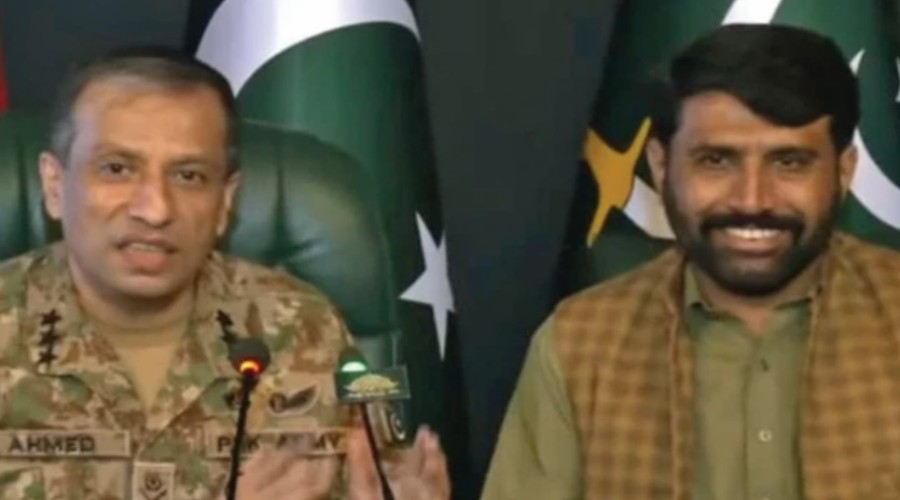
He presented the man alive before the media and called the incident another Indian “false flag operation”.
“The so-called terrorist incident is another false flag staged by the Indian military. I will explain the details step by step,” Chaudhry said at a press briefing.
He said he was responding to the Indian military’s claim that it had carried out an anti-terror operation in IIOJK on September 29.
The military spokesperson said the incident began that night, when the Indian military’s corps in IIOJK posted on social media that a joint search operation had been launched by the Indian Army, Jammu and Kashmir Police, and the Central Reserve Police Force in the Korag-Yousmarg area. The post said troops noticed suspicious activity and that a gunfight began after they challenged the people there. It claimed one “terrorist” was killed.
Chaudhry said that seven hours later, the Indian military reported that it had found the body of a Pakistan-based LeT member and identified him as Mohammad Asif, also known as Hashim Moosa.
Indian media had reported that Asif was killed in an operation in IIOJK and had previously served in the Pakistan Army. The reports said he was born on March 7, 1980, joined the army in 2000 under service number PA-3106947, and retired as a Havildar. They also claimed he joined the Special Services Group (SSG) in 2005 and served with its 4 Commando “Yalgar” Battalion.
The reports further claimed Asif was posted in Balochistan from 2006 and took part in about 10 operations against Baloch insurgents. They said he was credited with 13 “personal kills” and served on former president Pervez Musharraf’s security team from 2006 to 2009.
Chaudhry said Indian news agency ANI had reported details about “Asif”, including his joining date, service number, retirement, photograph, and alleged SSG service. “A very interesting story is being made, and you have a face as well. You may recall the false flags of Uri, Pahalgam and Pulwama,” he said.
He added that the Indian government later said, through the Home Affairs Ministry and Press Information Bureau, that its army had killed an LeT “commander” identified as “Musa aka Asif Fauji” in an intelligence-led operation.
“According to the Indian government, this was a serious blow to the LeT network, and Asif had been operating in Jammu and Kashmir since 2022 and was involved in major attacks. Asif was killed after six months of a long operation,” he said.
The spokesperson said Indian media repeated the government’s claims that a former Pakistani SSG soldier had been killed.
“Now that the Indian military has claimed Musa is a former SSG Havildar, the question is: where is Musa?” he said before presenting Asif to the audience.
“Here is the gentleman. You can see him. Please tell us about yourself. I would ask my friend Havildar Asif to say something.”
Asif said he had received calls from Indian numbers since the previous day asking about him. He had also seen social media posts saying he had been killed in an Indian military operation.
“I was at home when I heard these false reports in the Indian media. This is a serious and false accusation, and my presence here shows that I am alive,” he said.
“I joined the Pakistan Army in 2000, joined the SSG in 2005, served for 18 years, and retired in 2023,” Asif added.
Chaudhry said there were six reasons behind what he called India’s repeated false claims. He said India made such claims to hide its own actions and accuse others of terrorism.
He alleged that India was involved in supporting terrorist groups and mistreating Muslims, Sikhs, Kashmiris, Dalits, tribal communities and Christians. He said false stories were used to hide these actions and had been shared for decades.
The DG ISPR also said that such claims had encouraged India to carry out targeted killings beyond its borders.
“A normal person cannot understand the reason for this drama,” he said. He added that such stories were used to support India’s actions in IIOJK.
He said IIOJK was heavily guarded, with a soldier or security official deployed for every 10th Kashmiri. He added that nearly one million personnel were stationed there.
“Havildar Asif does not need to cross the border to encourage Kashmiris,” he said, adding that Indian actions and the denial of Kashmiris’ right to choose their future were behind their resistance.
“If you want a fight, face us as you did in Marka-e-Haq, and let us teach you a lesson,” Chaudhry warned.
He said India was focused on Pakistan and made up stories about it. He also warned that if India wanted another conflict, Pakistan was ready.
“This time, the cost Pakistan will make India pay for its serious mistake will be very, very high,” he said. Speaking about the Makkah agreement, Chaudhry said troop deployments to Saudi Arabia were confidential.
He said putting the agreement’s defence plans into action was an operational matter and should not be discussed in the media. “There should be complete clarity that Pakistan’s commitment to Saudi Arabia’s security and sanctity is absolute,” he said.
Asked about cross-border terrorism from Afghanistan, the DG ISPR said the army worked under the federal government, as required by the Constitution. He said it was the federal government’s role to coordinate with provincial governments.
He added that Pakistan would not compromise on its territorial integrity and sovereignty and would take all necessary steps to protect them.
Asked about India’s standing in the world, he said India’s image had been exposed. He referred to comments by the Canadian prime minister and US secretary of state about Indian terrorism.
On operations against the Afghan Taliban, Chaudhry said the Afghan Taliban had chosen to support terrorism. He asked international media to investigate why Afghans were involved in attacks inside Pakistan and what Afghanistan was doing about it.
He said Pakistan had no issue with the Afghan people, but objected to the Afghan Taliban government, which he described as unelected and unrepresentative. He said terrorist groups, including ISKP and ETIM, were operating there and that Pakistan was fighting them.
Asked about the PTI’s planned long march, he said the army had no role in politics and would not comment on political matters. “Politics is for political parties and the government,” he said. He called for following the National Action Plan to eliminate terrorism. “The state comes before politics; the state comes before democracy too,” Chaudhry said.
Reported by: Our Correspondent I Islamabad